EV charger installation in an older San Francisco home almost always runs into the same question before the first wire is pulled: what is actually behind the walls? In a Victorian in the Mission or an Edwardian near Noe Valley, the answer is often knob-and-tube wiring, and that changes how a charger circuit gets planned, permitted, and installed.
Why San Francisco’s Historic Housing Complicates EV Charging
San Francisco has one of the highest rates of EV ownership in Northern California, and it also has one of the oldest housing stocks in the state. Victorian and Edwardian homes throughout the Mission, the Castro, and Noe Valley were built decades before anyone imagined a car plugging into a house, and many still carry some of their original electrical system: knob-and-tube wiring, a 60 or 100 amp panel, or both. That combination means a project that would be routine in a newer suburb, adding a 240-volt circuit for a Level 2 charger, often needs a broader electrical assessment first.
This is not a reason to assume your home is unsafe or that an EV charger is out of reach. It is a reason to start with an assessment rather than a charger purchase, since the answer to “can I install this?” depends entirely on what your specific panel and wiring can support.
The city’s dense, tight urban lots add a practical wrinkle of their own. A detached garage on a narrow lot, a shared driveway serving a row of Victorians, or a condo garage with multiple tenants all change where the charger can realistically go and how far the wiring has to travel to get there. None of that changes the underlying electrical question, but it does mean two homes on the same block can end up with very different scopes of work depending on garage layout alone.
Knob-and-Tube Wiring: What It Is and Why It Matters Here
Knob-and-tube wiring was the standard residential wiring method in the early twentieth century, using ceramic knobs to anchor conductors and ceramic tubes to guide them through framing. It is ungrounded, lacks the insulation standards of modern wire, and was never designed for the sustained, high-amperage load that a Level 2 EV charger circuit draws for hours at a time. On its own, intact knob-and-tube wiring in an untouched circuit is not automatically dangerous. The concern is what decades of modifications, insulation added around the conductors during energy retrofits, and general age do to a wiring method that was never built with today’s electrical loads in mind.
For EV charging specifically, the practical question is not whether knob-and-tube wiring exists somewhere in the house. It is whether the specific circuit path from the panel to the charger location still relies on it, and whether the panel itself has the capacity and modern protection to safely support a dedicated 240-volt, 40 to 50 amp circuit in the first place.
Can You Install an EV Charger With Knob-and-Tube Wiring?
In its original, unmodified state, knob-and-tube wiring cannot support the load of an EV charger circuit, because a Level 2 charger requires its own dedicated 240-volt circuit rather than running through existing branch circuits. In practice, this means the charger circuit itself is almost always new wire run from the panel, regardless of what other wiring exists elsewhere in the house. The real question an electrician is answering during the assessment is whether the panel has room and capacity for that new circuit, or whether reaching the panel means passing through, and disturbing, sections of old wiring along the way.
- If the panel has adequate capacity and a clean path to the charger location, a new dedicated circuit can often be added without touching the rest of the home’s wiring
- If the panel is undersized, at or past its rated life, or missing modern grounding, a panel upgrade typically comes first
- If knob-and-tube segments sit directly in the planned circuit path, those sections get replaced as part of the project rather than worked around
- If your home is fully rewired already but the panel is original, the panel itself is usually the limiting factor, not the wiring downstream of it
What Happens During a Panel and Wiring Assessment
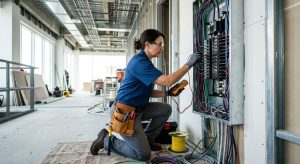
A proper assessment starts with a load calculation: how much capacity your panel currently has, how much your existing appliances and circuits use, and how much headroom is left for a dedicated EV circuit. From there, the electrician traces the likely path from the panel to your parking spot, whether that is a garage, a driveway, or a shared space in a multi-unit building, and identifies whether that path involves any original wiring.
What each stage checks
- Assessment: panel age, capacity, and any knob-and-tube in the circuit path
- Circuit plan: new dedicated run vs panel upgrade vs load management
- DBI permit: electrical trade permit, often same-day for standard installs
- PG&E coordination: required only if the main service itself changes
“In a lot of Mission and Noe Valley Victorians, the wiring itself isn’t the scary part. It’s finding an outlet with the black wire on the silver screw and the white wire on the brass one, reversed polarity from some past repair. That’s the kind of thing you want a licensed electrician checking before any new circuit goes in, not after.”
– Roni, Local Trusted Electricians
The DBI Permit Process for EV Chargers
Under San Francisco’s building code, installing electric vehicle supply equipment generally requires an electrical trade permit from the Department of Building Inspection, with one narrow exception: a plug-in charger using an already-approved receptacle outlet does not require a separate permit. Since most homes needing a new dedicated circuit will not have that pre-approved receptacle in place, the electrical permit is the norm rather than the exception for a hardwired or newly-wired Level 2 install.
California state law treats EV charging infrastructure as a matter of statewide concern, and under Government Code Section 65850.7, cities are required to limit their review of standard residential EV charger permits to health and safety issues rather than open-ended discretionary review, which is part of why a straightforward installation performed by a registered electrical contractor can often move through DBI quickly.
Coordinating With PG&E on Service Upgrades
A new dedicated circuit for a charger, on its own, usually does not require anything from Pacific Gas and Electric beyond the standard DBI permit and inspection. Where PG&E becomes directly involved is when the project requires a change to your main electrical service, most often because your existing 60 or 100 amp service does not have room for a new panel large enough to support the EV circuit alongside everything else in the house. In that scenario, your electrician secures the DBI electrical permit first, then coordinates with PG&E to approve and schedule the service change, since any modification to the main service point requires utility sign-off in Northern California regardless of which city you are in.
This two-step sequence, permit first, utility coordination second, is the most common source of delay on panel upgrade projects in San Francisco, simply because PG&E scheduling can take longer than the DBI permit itself. Building in that lead time when you are planning an installation date avoids the frustration of a charger sitting in its box while paperwork moves between departments.
What It Costs: Charger-Only vs Panel and Rewiring Combined
A charger-only installation, where an existing 240-volt circuit is available or the panel has clear capacity for a new dedicated run, is the least expensive path and the fastest to schedule. Costs climb from there depending on how much of the home’s original wiring stands between the panel and the parking spot, and whether the panel itself needs to be replaced rather than simply added to. A full scope that includes a new 200 amp panel, remediation of any knob-and-tube wiring in the circuit path, and PG&E coordination for the service change represents a meaningfully larger project than a straightforward charger add-on.
Homes in tight urban lots, which describes a large share of San Francisco’s housing stock, also tend to see higher labor costs for any trenching or conduit routing between a detached garage and the main panel, and historic preservation considerations in some Victorian and Edwardian properties can limit how walls are opened up, which affects both cost and timeline. A contractor working in a home with plaster walls rather than modern drywall also needs different patching techniques after any wiring work, which is worth asking about upfront since plaster repair is a different skill than drywall repair and not every general electrician does both well.
Getting quotes that separately itemize the charger, the circuit, any panel work, permit fees, and plaster or wall repair makes it much easier to compare contractors on an apples-to-apples basis, rather than trying to reverse-engineer what a single bundled number actually includes.
PG&E and Federal Rebates That Help Offset the Cost
PG&E’s Residential Charging Solutions Rebate program covers a portion of the cost for approved EV charging equipment, including load-management devices that can reduce or eliminate the need for a full panel upgrade in some homes, since these devices are specifically designed to work within existing service capacity rather than replacing it. A licensed California electrician is required to perform the installation, and the program is limited to one rebate per residential account, so it is worth confirming current equipment eligibility before purchasing a charger.
Separately, the federal Alternative Fuel Vehicle Refueling Property Credit under Section 30C offers 30 percent of installation cost, up to $1,000, for qualifying residential installations. This credit is not available everywhere: the IRS requires the property be installed in an eligible census tract, typically a low-income or non-urban area, so a San Francisco address does not automatically qualify and is worth checking before you count on the credit. The deadline matters just as much as the eligibility rules: the credit only applies to equipment placed in service on or before June 30, 2026, after which it is no longer available for new residential installations under current law.
New 2026 Code Considerations for EV Circuits
The 2026 National Electrical Code introduces a requirement that receptacles used specifically for EV charging be listed and rated for that use, rather than relying on a general-purpose 240-volt receptacle. It also introduces high-frequency ground fault protection for certain outdoor circuits, which is directly relevant to EV charging because inverter-based charging equipment can produce high-frequency leakage current that traditional GFCI protection was never designed to interpret correctly. None of this changes whether your home can get an EV charger. It does mean the specific hardware and protection devices your electrician specifies should reflect current code, not whatever was standard a few code cycles ago, which is one more reason this project benefits from a licensed electrician who works in San Francisco’s older housing stock regularly.
Getting It Right in a Victorian or Edwardian Home
The path to a working EV charger in an older San Francisco home almost never starts with the charger itself. It starts with an honest look at the panel, the wiring between the panel and the parking spot, and an accurate read on whether the project is a straightforward circuit add or a larger panel and wiring project. Getting that assessment right the first time avoids the more expensive scenario: installing a charger, discovering the circuit cannot safely support it, and paying to redo the work.
It also protects the character of the home itself. A rushed job that opens more plaster than necessary, or reroutes a circuit through the shortest path rather than the sensible one, can leave marks on a Victorian or Edwardian interior that are far more expensive to fix than the electrical work itself. An electrician who has done this kind of project across the Mission, Castro, and Noe Valley before will plan the route with that in mind from the start, not as an afterthought once the walls are already open.
Our EV charger installation and wiring teams are familiar with the knob-and-tube patterns common across the Mission, Castro, and Noe Valley, and our San Francisco electricians can walk your property, trace the wiring path, and give you a clear answer on what your home needs before you buy anything.