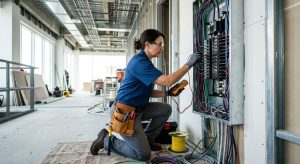
Why Orange County Businesses Are Outgrowing Their Electrical Panels
A commercial electrical panel upgrade is rarely something a business owner plans for months in advance. It usually starts as a small annoyance: a breaker that trips once during the lunch rush, a dimming light when the walk-in cooler kicks on, or an electrician who shows up for something unrelated and mentions, almost in passing, that the panel is at its limit. Orange County’s mix of retail centers, restaurants, medical offices, and light industrial space means a lot of buildings were wired decades ago for a much smaller electrical load than what modern equipment actually demands.
Point of sale systems, commercial refrigeration, HVAC upgrades, security systems, and now EV chargers all draw power that older 100-amp or 200-amp commercial services were never designed to carry at once. When a business adds capacity faster than its electrical infrastructure keeps up, the panel becomes the bottleneck, and that bottleneck eventually shows up as a service call.
It helps to think of the electrical panel as the building’s distribution hub rather than a single piece of equipment that either works or doesn’t. Utility power enters at the service entrance, passes through the main breaker, and then splits into the branch circuits that feed lighting, HVAC, refrigeration, outlets, and any dedicated equipment circuits. The panel’s amperage rating sets a hard ceiling on how much of that can run at once. A building can look perfectly fine on a slow Tuesday morning and still be operating right at its limit the moment every piece of equipment turns on together during a busy Saturday afternoon.
That’s part of why panel capacity issues tend to surface gradually rather than all at once. A business rarely adds enough equipment in a single week to trip a breaker immediately. Instead, it’s a new POS terminal here, an upgraded walk-in cooler there, a security system added during a remodel, and eventually the cumulative load crosses a threshold the original panel was never sized for. By the time the first breaker trips during normal hours, the building has often been running close to capacity for months.
The Warning Signs We See Most Often
Most commercial panel upgrades in Orange County start with one of a handful of recurring symptoms. None of these on their own means a business needs a full upgrade, but together they’re a pattern worth paying attention to.
- Breakers that trip repeatedly under normal daily operation, not just during a power surge
- Lights that dim or flicker when large equipment cycles on, such as HVAC compressors or kitchen appliances
- A recent tenant improvement, remodel, or equipment addition that increased the building’s total electrical load
- Warm panel covers, a persistent burning smell near the panel, or visible scorch marks
- An electrician or inspector flagging the panel as undersized during an unrelated service call
Any one of the first two symptoms, if it happens once during unusual conditions, is often nothing. The pattern that matters is repetition during ordinary business hours. A breaker that trips consistently is the panel communicating that something in the building’s electrical demand has outpaced its capacity.
Context matters here more than most business owners expect. A breaker tripping once during a summer heat wave, when every HVAC system in the county is working overtime, isn’t necessarily a sign of a problem. A breaker tripping every few days during ordinary operation, with no unusual weather or equipment use, is a different story. The distinction between an isolated event and a repeating pattern is often the first thing an electrician asks about on a service call, because it changes whether the fix is a simple circuit adjustment or a full panel evaluation.
It’s also worth paying attention to how a business responds to these signs in the moment. Resetting a tripped breaker and moving on is a natural first reaction, but a breaker that keeps needing to be reset is not resolving itself. Each trip is the breaker doing exactly what it’s designed to do: cutting power before an overloaded circuit becomes a fire risk. Repeated resets without an underlying fix just mean the same overload condition keeps recurring, and every cycle puts additional wear on the breaker itself.
These patterns aren’t unique to Orange County, but they show up with real regularity here because of the region’s building stock. Electrical fires tied to distribution and lighting equipment remain a measurable risk in non-home properties nationally, with an estimated 16,930 annual structure fires and roughly $718 million in direct property damage reported by the NFPA in properties other than homes, and mercantile and business properties account for a significant share of that total. Aging panels that were never sized for today’s equipment are part of that picture.
What Actually Drives the Cost of a Commercial Panel Upgrade
There’s no single number that answers “how much does a commercial electrical panel upgrade cost,” because the panel hardware itself is usually the smallest part of the bill. The real cost drivers are:
- Amperage jump. Moving from 100 to 200 amps is a common benchmark for a growing small business, but a larger retail space, restaurant, or light industrial unit may need 400 amps or more.
- Service entrance work. If the utility service itself needs to be upsized, not just the panel, that adds meaningful cost and typically requires coordination with Southern California Edison.
- Labor, permitting, and inspection fees. These often make up more of the total than the panel hardware, especially when an engineered load calculation or plan check is required by the city.
- Subpanels. If the new capacity needs to be distributed to multiple areas of a larger building, adding subpanels increases scope.
Industry cost guides that track commercial electrical pricing generally place a standard commercial panel upgrade in the range of roughly $1,500 to $5,000 or more, with the higher end driven by amperage, service upgrades, and building complexity rather than the panel itself. A single-tenant office needing a modest capacity increase sits at the lower end of that range; a restaurant or retail buildout adding new HVAC, refrigeration, and EV charging infrastructure at the same time can land well above it.
“A panel upgrade isn’t a sign something went wrong. It’s usually a sign the business grew faster than the electrical system it started with. The businesses that plan for it ahead of a big renovation always come out better than the ones reacting to a tripped breaker on a Friday.”
– Razmik, Local Trusted Electricians
Retail, Office, and Hospitality Have Different Panel Needs
Orange County’s commercial mix means the “right” panel size depends heavily on what the building is used for. A standard office typically needs the least capacity of the three, since its load is mostly lighting, HVAC, and workstations. Retail spaces add refrigeration, signage, and point-of-sale equipment on top of that baseline. Restaurants and hospitality properties tend to need the most headroom, since kitchen equipment, walk-in refrigeration, and heavier HVAC loads all run simultaneously during peak hours.
This is also where planned growth matters. A retail tenant improvement that only accounts for today’s equipment often gets revisited within a few years once a business adds a second point-of-sale terminal, upgraded refrigeration, or a customer-facing EV charging station. Sizing the panel with some room for that kind of growth, rather than exactly to the current load, tends to save a second disruptive project down the line.
Multi-tenant commercial buildings add another layer of complexity that’s common across Orange County’s retail centers and office parks. Each tenant space typically has its own subpanel fed from a larger main service, and a single undersized tenant improvement can end up constraining what the next tenant is able to install. Property managers who plan panel capacity at the building level, rather than tenant by tenant, generally have an easier time accommodating new leases without a electrical rework every time a space changes hands.
Light industrial and warehouse space in Orange County carries its own set of considerations as well. Equipment like compressors, conveyor systems, and specialized machinery often runs on three-phase power rather than the single-phase service found in most offices and retail spaces, and that distinction alone can significantly change both the panel specification and the cost of a service upgrade.
Permits and Utility Coordination in Orange County
A commercial panel upgrade almost always requires a permit, and Orange County’s many individual cities each run their own permitting process through their local building department. That means the timeline and specific requirements can vary depending on whether the property sits in Anaheim, Irvine, Santa Ana, or one of the county’s other jurisdictions, even though the underlying electrical code is largely the same.
Any project that changes the service size, not just the panel internals, also requires coordination with Southern California Edison to confirm the utility connection can support the new load. This step is often the part of the timeline business owners underestimate, since utility scheduling can take longer than the actual electrical work.
A licensed electrician who regularly works across Orange County’s cities will typically know which departments require an engineered load calculation upfront and which allow the electrician’s own calculation to satisfy the permit, which can meaningfully change how quickly a project gets approved.
It’s worth building the permit timeline into any renovation schedule rather than treating it as an afterthought. A business that plans a remodel around a fixed opening date, and only pulls the electrical permit once construction is already underway, is the most common way a panel upgrade turns into a scheduling problem. Filing the permit and confirming SCE’s availability as early as possible, ideally before the rest of the buildout is finalized, gives the whole project more room to absorb any delays without pushing back an opening date.
What the Upgrade Process Actually Looks Like
- Load calculation. The electrician evaluates current equipment, connected load, and any planned additions to determine the appropriate new panel size.
- Permit and utility coordination. The permit is filed with the city, and SCE is contacted if the service size itself is changing.
- Scheduling the outage. Panel work requires shutting off power to the building or affected area, so this is typically planned outside of business hours or during a slower period.
- Installation and inspection. The new panel is installed, connected, and inspected by the local AHJ before it’s approved for use.
For most standard commercial panel upgrades, the on-site electrical work itself can often be completed in a single day once permits are approved. Larger jobs involving a service upgrade or new subpanels for a multi-tenant building typically take longer, mostly due to permitting and utility scheduling rather than the physical installation.
Planning Ahead for EV Chargers and Future Growth
One factor increasingly shaping panel sizing decisions in Orange County is EV charging. California’s Title 24 building standards already require a percentage of parking spaces in new commercial construction and qualifying alterations to be EV-capable or EV-ready, with specific thresholds set out in the CALGreen code’s commercial EV charging infrastructure requirements. Even a business that isn’t installing chargers today may be required to account for that future capacity during a renovation, which is exactly the kind of consideration a load calculation should catch before the panel is sized.
The U.S. Department of Energy’s Alternative Fuels Data Center tracks these EV charger building standards at the state level, and California’s requirements are among the more comprehensive in the country. For any Orange County business planning a remodel, expansion, or new build, it’s worth raising EV readiness with the electrician during the load calculation stage rather than as an afterthought, since retrofitting panel capacity for chargers after the fact almost always costs more than building it in from the start.
Working With a Licensed Electrician Who Knows Orange County
Every city in Orange County runs its own permitting process, and Southern California Edison’s timelines can vary depending on the scope of the service change. A commercial panel upgrade done right accounts for the building’s current use, its likely growth, and the specific jurisdiction’s permitting quirks, not just today’s breaker panel. Local Trusted Electricians serves businesses across Orange County with licensed, insured electricians who coordinate every permit and utility step so a panel upgrade gets done once, and gets done right.