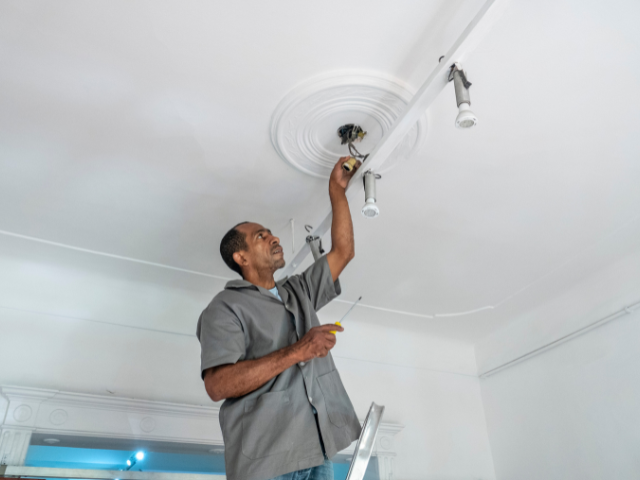
Recessed lighting — can lights, pot lights, or downlights — provides clean, shadow-free illumination integrated into the ceiling. When installed correctly it transforms a room: it eliminates the single overhead pendant look, allows zoned lighting through multiple circuits and dimmers, and creates a finished architectural appearance that suits both modern and traditional spaces. The installation requires correctly rated housings for insulation and fire separation conditions at each location, dimmer switches matched to the LED trim, and in many cases new wiring run from the panel to circuits that didn’t previously exist.
From IC-rated cans to attic-access methods and dimmer compatibility — here’s what homeowners need to know about recessed lighting before requesting service.

A recessed lighting project begins with layout planning — fixture placement, circuit configuration, and switch locations. In rooms with attic access, wiring is run above the ceiling without opening finished drywall. In rooms without attic access, wiring is fished between fixtures through small access holes rather than opening entire sections. Openings are cut at each fixture location, housings are installed and secured, wiring is connected, and LED trim and dimmers are installed and tested for full dimming range.

IC-rated housings are required in any insulated ceiling — standard housings not rated for insulation contact can overheat when insulation is installed over them, creating a fire risk. California additionally requires airtight-rated fixtures or sealed penetrations to prevent conditioned air from escaping into attic space, which degrades the building thermal envelope and violates current energy code. We apply both IC and airtight requirements on every California recessed lighting job.

LED fixtures require LED-compatible dimmers — using an incandescent dimmer with LED trim causes flickering and buzzing.

With attic access, ceiling damage is minimal — the electrician works from above and the only ceiling work is the fixture opening cuts. Without attic access, wiring is run through small holes at each joist bay using flexible fishing tools, leaving only small access points that a painter can address in a few hours.
Recessed lighting across 54 cities in California and New Jersey. Find your city below.
Here’s what homeowners say about our recessed lighting installation service. Every review is from a verified customer in Southern California.
★★★★★
“Fourteen recessed cans in our living room and dining room. They used attic access and didn’t open a single ceiling drywall hole. Dims perfectly with no flicker. Exactly the look we wanted.”
★★★★★
“No attic above our kitchen but they fished the wire through with minimal access holes. Patching was done the same afternoon and the recessed lights look like they’ve always been there.”
★★★★★
“Recessed lighting in three bedrooms with IC-rated fixtures to meet our insulated attic requirements. Clean install, dims smoothly, and they matched the trim ring color exactly.”
Helpful electrical guides, safety tips, and local service advice for Anaheim homeowners.

Table of Contents 24-Hour Electrician in Pasadena: Immediate Emergency Response Signs You Need an Emergency Electrician in Pasadena What 24/7
IC-rated, LED-compatible, code-compliant — fixed quote.
Has your property been evacuated or marked unsafe? Wait until civil authorities officially allow entry. Receding water does not automatically mean a building is safe to enter.
| Property Access & Electrical Inspection Protocol | |
|---|---|
| ⚠️ | Flood-Exposed Systems: Our electricians recommend having all flood-exposed wiring, service panels, and outlets evaluated before any circuits are energized or used again. |
| ✓ | Requesting Service: Once official entry access is permitted, call with your address and a description of what areas were affected by water. |
| ✓ | Future Preparation: For future weather events, a safety inspection can identify existing electrical concerns while the property is completely dry and safe. |