Table of Contents
- The Future of Deck Lighting: 2026 Trends and Innovations
- Foundation of Modern Deck Design: Trends Shaping 2026
- Smart and Low‑Voltage Lighting: The Core of 2026 Deck Trends
- DIY Installation and Safety Guide for Deck Lighting Upgrades
- Enhancing Deck Design with Advanced Accessories and Trends
- Answers to Your Deck Lighting Questions
- Bringing Your Deck Vision to Life with the Latest Trends
The Future of Deck Lighting: 2026 Trends and Innovations
Deck lighting and accessory trends in 2026 are reshaping how we use our outdoor spaces. The year ahead brings a blend of smarter technology, better efficiency, and a growing desire for outdoor living that extends well past sunset.
2026 is an important year as ultra-efficient LED advancements, broader smart-home adoption, and a cultural shift toward viewing the deck as part of the home converge. One Hour Heating & Air Conditioning indicates that lighting control and automation using home apps are widely available and user expectations are expanding to include control of lights located outside of the home. As this technology matures, more realistic, responsive lighting becomes accessible for decks of every size and style.
Smart, automated systems let homeowners adjust color, brightness, and timing from a phone. New LED technology continues to push energy savings further without sacrificing warmth or ambiance. Layered design—combining task, accent, and ambient light—adds depth and comfort. Safety and security lighting gains traction, and Bradford Heating & Air Conditioning underscores that safe exterior installation demands GFCI protection, moisture-resistant wiring, and code-conscious work. Our licensed and insured electricians specialize in outdoor and landscape lighting across California and New Jersey, with same-day availability when you need it most.
These innovations are part of a broader 2026 movement toward more sophisticated deck design. Materials, layout, and integrated systems are all evolving to support seamless outdoor living, making now the ideal time to reimagine what your deck can do.
Foundation of Modern Deck Design: Trends Shaping 2026
The design elements used to illuminate decks have become the hottest design trend of outdoor living for 2026, but it is only one part of a much larger evolution. Homeowners across California are now designing decks in layers as outdoor living rooms to extend comfort and function well beyond the back door. Decks are being designed with multiple levels and zones for dining, lounging and preparing meals. Deck design layers now extend beyond the back door of the home with different design elements being blended such as composite decking materials, aluminum and steel accents, covered areas, benches and planters, to create focal points on deck structures.
Step lights mark elevation changes on multi-level decks. Under-rail installations highlight the contrast of mixed materials. Post lights define the boundaries of covered spaces. Ambient string lights soften seating areas and planter edges.
The following table compares trending deck accessories that are reshaping outdoor spaces this year:
| Accessory Type | Trending Features | Installation Complexity | Estimated Cost Range |
|---|---|---|---|
| Smart Lighting Controller | Wi-Fi or Bluetooth connectivity, app scheduling, voice assistant integration, motion sensing, customizable scenes | Professional recommended | $200–$500 per controller |
| Low-Voltage Path Light | LED, durable metal or composite housing, warm white color temperatures, stake-mount design | Moderate | $50–$120 per fixture |
| Recessed Step Light | Flush-mount design, anti-glare lenses, aluminum or stainless trim, dimmable options | Professional recommended | $60–$180 per light |
| Outdoor-Rated String Light | Heavy-duty cord with waterproof sockets, commercial-grade LED bulbs, linkable up to 100 feet | DIY-friendly | $40–$100 per string |
| Fire Table | Propane or natural gas, glass wind guard, hidden tank compartment, auto-ignition, multiple finishes | Professional recommended | $400–$1,200 per unit |
Each has its own balance of appeal and difficulty to install.
Today’s deck design movement treats lighting and accessories as fundamental layers rather than add-ons. Five Star Service advises that even low-voltage systems benefit from professional planning to avoid tripping hazards and to ensure compliance with local electrical codes. Low-voltage pathway lights define circulation, recessed step lights keep level changes safe, and app-based controllers let homeowners adjust ambiance from a phone. Many homeowners are also now requesting app-controlled lighting as part of their 2026 outdoor plans.
As the demand for intelligent, code-compliant deck lighting systems increases, the technologies behind it, from low-voltage circuits to app-based controls, become the focal point. These systems are what we install every day across Southern California with same day availability for lighting upgrades.
Smart and Low-Voltage Lighting: The Core of 2026 Deck Trends
This year’s design trends place smart and low-voltage lighting at the center of outdoor living spaces. Lighting adds function and beauty to the heart of today’s modern decks.
Smart App-Controlled Deck Lighting Systems
These systems connect over Wi-Fi or Bluetooth to a central hub or directly to fixtures.
- On/off scheduling: program lights to activate at sunset and turn off later.
- Dimming control: slide brightness from a soft 10% glow up to full output for tasks.
- Color temperature tuning: shift between warm white (~2,700K) and cooler tones (~5,000K).
- RGB color selection: pick from broad color ranges for holidays or events.
| System | App Control Capabilities | Voice Assistant Integration | Brightness Levels (Lumens) | Color Options | Price Range (Approx.) |
|---|---|---|---|---|---|
| Philips Hue | RGB and white tuning, scheduling | Alexa, Google, Apple HomeKit | 800–1,200 lm per spotlight | Full RGB + warm-to-cool white | $200–$500 |
| Ring Smart Lighting | Scheduling, motion alerts | Alexa | 400–800 lm per path light | Adjustable white | $150–$350 |
| Kichler Smart Landscape | Dimming, scheduling, zone control | Alexa, Google | 300–900 lm depending on fixture | Warm white, select RGB | $250–$600 |
| FX Luminaire Luxor | Zone color and intensity, timers | Alexa, Google (via hub) | 250–1,000 lm per fixture | Full RGBW, zoned | $400–$1,200 |
| Sylvania Smart+ Outdoor | Scheduling, scenes | Alexa, Google | 600–800 lm per flood light | 16M colors + white | $100–$250 |
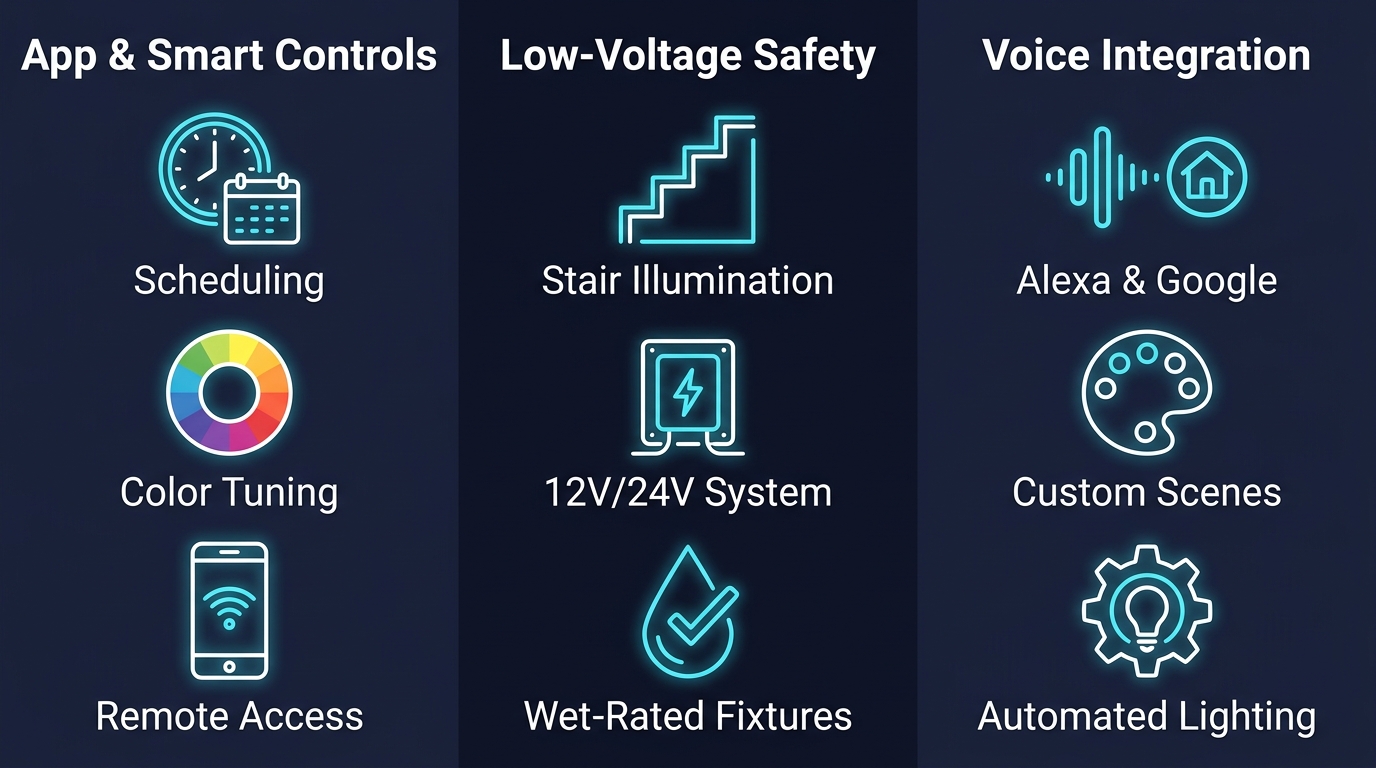
Low-Voltage LED Stair Lights: Safety and Ambiance
Low-voltage stair lights address one of the most critical safety zones on any raised deck. These systems operate on 12V or 24V architecture, with a transformer stepping down standard 120V household current to a safer level; the transformer typically mounts near a GFCI-protected outlet.
Falls are much less likely to occur when steps and overhangs are illuminated. Photocell sensors are used to turn lights on at dusk and motion sensors to turn lights on only when someone is near, conserving energy. The phrase low-voltage LED stair lights is often used by homeowners to describe a safety and aesthetic balancing act for decks.
Both recessed and surface-mounted fixtures require IP65 waterproofing for continued outdoor exposure. All final wiring, conduit runs and transformer connections are to be done by a licensed electrician to ensure proper wire gauge and transformer size to prevent voltage drop.
Integrating Voice Assistants and Automation
Voice assistants allow hands-free control of deck lighting after pairing fixtures with Amazon Alexa, Google Home, or Apple HomeKit.
Use automation routines to combine actions into single triggers:
- "Movie night" scene: dim most fixtures to a warm low level to reduce screen glare while keeping paths visible.
- "Security sweep" routine: bring fixtures to higher brightness for a short period when needed.
- Schedule-based triggers: run automatically at sunset or other set times.
Electrical rough-ins and transformer placements are done by us so smart features operate reliably. We ensure homeowners know costs up front with fixed quotes. Every transformer and hardwired connection is to be done by a licensed, insured electrician to ensure code compliance and safe and inspection ready work.
DIY Installation and Safety Guide for Deck Lighting Upgrades
We bring that low-voltage look to life by starting with a safe, code-smart installation.
Step-by-Step: Installing Low-Voltage LED Stair Lights
- Pick a transformer spot near a GFCI-protected outdoor receptacle.
- If the run to the furthest fixture exceeds 100 feet, use 12 AWG low-voltage cable to limit voltage drop; for shorter runs, 14 AWG is acceptable.
- Secure the transformer at least 12 inches above ground with the low-voltage terminals positioned away from standing water.
- Lay and fasten the low-voltage cable.
- Use gel-filled wire connectors or heat-shrink solder connectors at every splice and fixture tap; avoid twist-on wire nuts outdoors.
- Fasten fixtures to the chosen surface and confirm the LED module is locked in place.
- Configure the transformer’s control to match your evening routine or to operate from dusk to dawn.
- Test the circuit before hiding the wires. Verify correct polarity and voltage with a multimeter at the first and last fixture and check for even brightness along the run, then conceal cabling once testing is complete.
Low-Voltage vs. Line-Voltage Deck Lighting Comparison
| Feature | Low-Voltage (12V-24V) | Line-Voltage (120V) |
|---|---|---|
| Safety | Shock risk is minimized; suitable for damp outdoor locations and accidental contact. | Higher shock hazard; GFCI protection and a licensed electrician are required for modifications. |
| Typical Applications | Path lighting, stair risers, rail accenting, and landscape accents—ideal for decks and gardens. | Area floods, security lights, and fixtures that need long throw and high lumen output. |
| Transformer Requirements | Plug-in 12V–24V electronic or magnetic transformer installed near a GFCI outlet. | Hardwired to a 120V branch circuit; no separate transformer required. |
| Cost | Generally lower material and installation outlay compared with line-voltage work. | Higher upfront cost due to permits, licensed labor, and outdoor-rated junction boxes. |
| DIY Difficulty | Easy to moderate; a careful homeowner can complete low-voltage work with basic tools. | Not DIY-friendly; new 120V circuits or outdoor modifications should be done by a licensed electrician. |
| Permitting | Plug-in low-voltage systems typically do not require a permit under most local codes. | Permit required and work must be performed by a licensed professional to meet code. |
Electrical Safety and Code Compliance for Outdoor Deck Lighting
- GFCI protection, NEC 210.8 requires GFCI-protected receptacles for outdoor outlets, including those feeding a low-voltage transformer.
- Listed lighting systems, NEC 411 requires low-voltage lighting to be listed and installed per the manufacturer’s instructions.
- Weatherproof in-use covers are required for receptacles when cords are plugged in outdoors.
When jobs move beyond basic low-voltage work (e.g. installing a new 120-volt circuit, running conduit, or adding a sub-panel), we direct homeowners to our licensed electricians; we handle permit-ready work.
Choosing the Right Wiring and Connectors
For runs under 100 feet, 14 AWG stranded low-voltage cable is affordable and easy to handle; for runs over 100 feet, use 12 AWG to limit voltage drop and maintain consistent LED brightness. Stranded conductors resist fatigue from temperature-related flexing better than solid wire in outdoor settings.
For a waterproof, flexible seal that performs in freezing conditions, Gel-filled connectors are a good choice, while Heat-shrink solder connectors form a permanent, insulated bond resistant to UV and rain.
With the basics of wiring, connections, and code handled correctly, your deck is ready for smarter controls and accessory upgrades while remaining safe and inspection-ready.
Enhancing Deck Design with Advanced Accessories and Trends
The foundational wiring is put in place and the code-compliant electrical backbone is established, then the “fun” part begins. There are a variety of deck accessories that allow the deck to become an extension of the home, creating a safe and fully lit outdoor living space. One of the more aesthetically pleasing safety features is decorative post caps that provide a finishing touch to the railing while incorporating lighting to further enhance the landscape.
In modern deck lighting designs, low-voltage LED systems lead the way for their energy efficiency and crisp illumination. Smart controls that allow scheduling, dimming, and motion activation are becoming standard, while integrated solar options continue to mature, offering a wire-free yet surprisingly bright alternative.
Knowledge of local conditions is important when selecting material that is most appropriate for the area. In coastal California, aluminum post caps resist salt-air corrosion and maintain their finish with minimal care. Composite caps are also good, as they withstand freeze/thaw conditions, and PVC is a budget-friendly option that performs well when properly sealed and maintained. All materials require some maintenance, and we recommend annually checking all connections, and making sure they are free of dust and grime.
When it comes to the light itself, there are distinct pros and cons for solar, wired LED, and self-contained battery LED light caps. The easiest of the three to install is the solar cap. But the light output is variable depending on the sun exposure. Wired LED caps that plug into a low-voltage power supply deliver the brightest, most dependable light and can be integrated into a smart home system, but they require a professional to connect the low-voltage power supply. Self-contained LED caps provide an easy to install middle of the road solution between the solar and wired LED caps, and deliver dependable output. Using high-quality wired components is essential if you are looking to light your landscape for multiple seasons.
While developing your outdoor lighting scheme, there are a number of related issues that will come up, including the impact of your lighting scheme on ongoing maintenance, your existing deck structure, and local building and electrical codes. These are worth investigating as you develop your outdoor lighting vision.
Answers to Your Deck Lighting Questions
Looking through this year’s popular deck lighting often brings up questions about which fixtures to use and what the installation is like.
What type of deck lighting is best? LED low-voltage lighting is the practical and energy efficient choice. They will last a long time and use less energy. For an inviting glow, the color temperature can be set to warm-white (2700K to 3000K) and all fixtures should be rated for outdoor wet locations to withstand outdoor moisture.
Does deck lighting need special electrical protection? Yes. Outdoor lighting must be wired on a GFCI-protected circuit to prevent electrical shock. A licensed electrician should be hired for the installation of new circuits or if there is hardwiring, as the work is rather simple and the outcome will be safe, and in compliance with local electrical codes. With the electrical work done, you can enjoy focusing on how the lights add to the style and mood of the deck.
Bringing Your Deck Vision to Life with the Latest Trends
Deck lighting and accessory trends for 2026 are taking shape: warm-tone LEDs, smart automated controls, and layered low-voltage fixtures. Translating these trends into a beautiful, functional deck depends on correct electrical work, so our licensed, insured electricians are essential to bringing that vision to life safely. We offer outdoor lighting installation, landscape lighting, and lighting repair with transparent upfront quotes, same-day availability, and local expertise in California and in New Jersey. Contact the localtrustedelectricians.com team today to schedule service and make your deck permit-ready and inspection-verified.
Transform Your Deck with Expert Installation
You’ve explored the top deck lighting and accessory trends 2026, from smart app-controlled systems to low-voltage LED stair lights. The article walked you through design foundations, safety codes, and the transformative potential of layered, app-controlled lighting. Now that you know what’s possible, it’s time to bring that vision to life with a safe, code-compliant installation. Our licensed, insured, and background-checked electricians specialize in outdoor and landscape lighting across California and New Jersey. We offer transparent, fixed upfront quotes and same-day service to get your project started quickly. Call (855) 904-2285 or visit our website to request a quote and schedule your installation. Turn the latest 2026 trends into a beautifully illuminated deck you’ll enjoy year-round.
Transform Your Deck with Expert Installation
Resources
- Expert HVAC Contractors Offering Quality Installation Services
- Affordable Heating Repair and Installation Services
- Emergency AC Repair by Trusted HVAC Specialists
- Air Conditioning and Heating Installation Specialists
- Reliable HVAC Maintenance and Repair Solutions
- Expert Heating and Cooling Installation Services
- Dependable Air Conditioning Repair Specialists
- Fast 24/7 Emergency HVAC Repair Service
- Professional Residential HVAC Maintenance Experts
- Trusted Air Conditioning Contractors for Homes
- Experienced HVAC Technicians for Emergency Repairs
- Reliable Air Conditioning Services Near You
- Expert HVAC Repair and Installation Services
- Licensed HVAC Contractors for Residential Homes
- Trusted Air Conditioning Repair Specialists
- 24/7 Emergency HVAC Repair Services Available
- Professional AC Installation and Repair Experts
- Ductless Mini Split Solutions for Home Cooling
- Reliable Furnace Repair and Maintenance Company
- Residential and Commercial HVAC Repair Specialists
- Central Air Conditioning Installation and Repair Experts
- HVAC Service Company for Installation and Repair