Table of Contents
- Should You Upgrade to a 200 Amp Panel Before Installing an EV Charger?
- Electrical Panel Capacity and EV Charger Requirements
- How a 100 Amp Panel Handles a Level 2 Charger or Tesla Wall Connector
- What a 200 Amp Panel Upgrade Adds to EV Charger Installation Costs
- Timelines, Permits, and 2026 Incentives for Panel Upgrades
- Panel Upgrade Questions Homeowners Ask Most
- Get a Fixed Quote for Your Panel Upgrade and EV Charger
Should You Upgrade to a 200 Amp Panel Before Installing an EV Charger?
When looking at the cost to upgrade to a 200-amp panel for an EV charger, this is often the first question for Anaheim homeowners who want to install Level 2 charging. From our experience installing EV chargers in Anaheim, we know that many homes, especially those built between 1950-1970, have 100-amp panels that can’t handle the additional load of the dedicated 240 volt, 50 amp circuit required to power a Level 2 charger. Before buying a charger, you must evaluate the capacity of your panel to make sure you’re not going to overload the system.
A Level 2 EV charger needs a dedicated circuit with 50-amp load and a 60-amp breaker, which puts a lot of demand on your home’s electrical profile. According to Electrical Panel Upgrade Authority, EV chargers are among the most common reasons that homeowners upgrade from 100 to 200 amps, along with central air conditioning and existing panel hazards. With a 200-amp panel you can have about 160 amps of sustained load under NEC continuous load rules, making it the standard for EV-ready homes.
An upgrade is needed based on the capacity of your home’s current panel and your future electrical needs, so the next step is to learn about how panel capacity and charger requirements are evaluated.
Key Takeaways
- Upgrading home’s electrical service is more than simply increasing the quantity of power.
- A 100-amp electrical panel may have difficulty supporting a Level 2 EV charger since charging circuits need to be sized for continuous loads.
- Installing a Level 2 EV charger in Anaheim may require more than just a charger if you have a 100-amp panel that cannot support it.
- The 2026 electrical panel upgrade incentives are quite different from previous years.
- How much does it cost to upgrade to a 200 amp panel for EV charging?
Electrical Panel Capacity and EV Charger Requirements
Upgrading home’s electrical service is more than simply increasing the quantity of power. It is making sure that the system can safely support current and future demands of devices, such as EV chargers, without overloading other circuitry in your home. Panel capacity is not a single, set value, but is instead a limit determined by how much continuous load is placed on it and the way people use their home’s electrical system. This means no annoying breaker trips, failed inspection, and rework later if you try to add a Level 2 charger or Tesla Wall Connector.
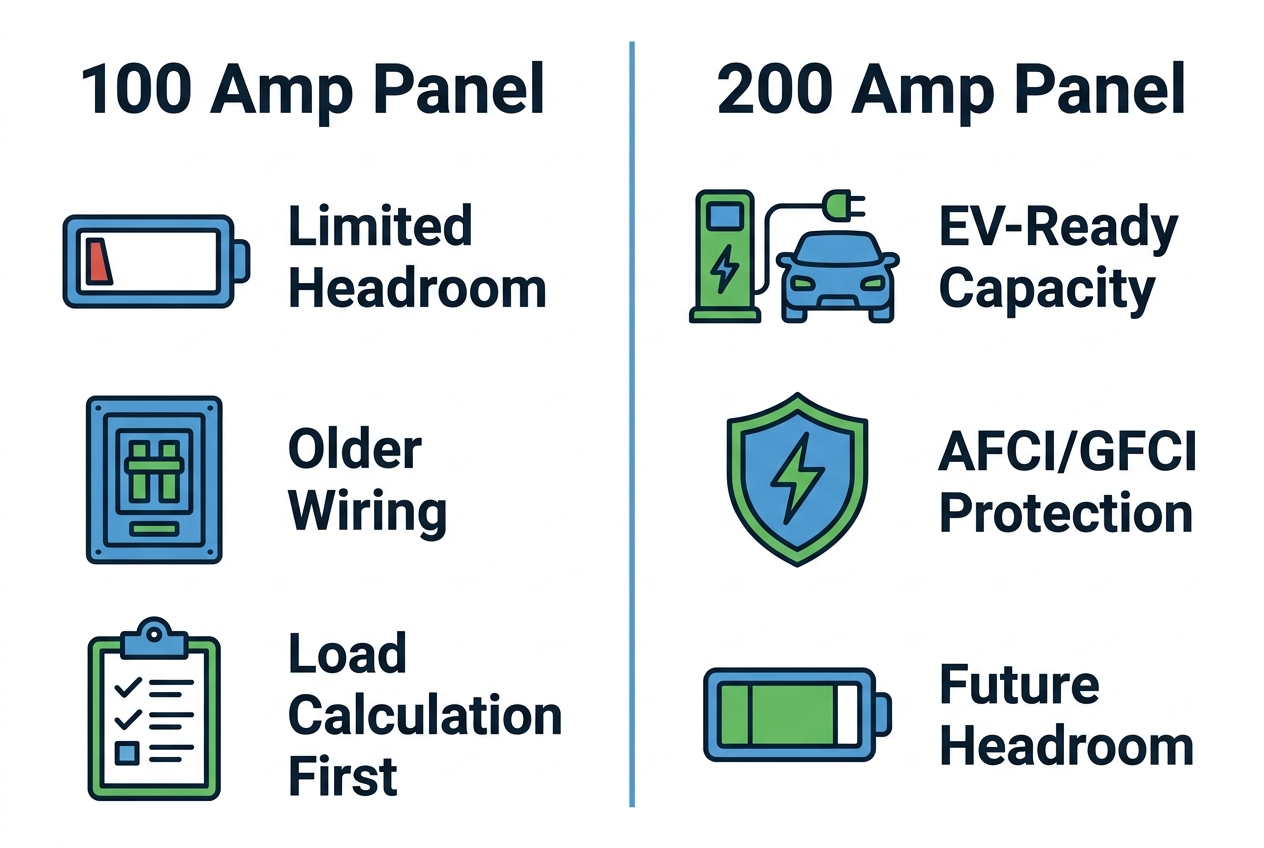
A 100-amp panel might have trouble with a dedicated 50-amp Level 2 circuit, since NEC treats EV charging as a continuous load requiring that the circuit be sized at 125% of the charger’s max amps. However, upgrading to a 200-amp panel for the EV charger allows for sufficient headroom to support both the charger and other house loads without tripping overload alarms.
Panel Capacity vs. Level 2 EV Charger Demand
| Factor | 100 Amp Panel | 200 Amp Panel |
|---|---|---|
| Sustained load limit | Roughly 80 amps under the 80% continuous-load rule | Roughly 160 amps under the 80% continuous-load rule |
| Typical Level 2 charger support | Often insufficient in homes built 1950–1970 without load management | Supports 48A/60A circuit requirements comfortably |
| Common upgrade trigger | EV charger added to legacy panel | EV charger plus central AC or panel replacement |
While a 100-amp panel has a limited sustainable capacity, adding a Level 2 charger can bring the system close to that limit, whereas a 200-amp panel provides the headroom to accommodate both the charger and all your daily appliances. It’s not just about the size of your panel, but the capacity math that allows you to charge your EVs at home.
According to NEC Article 625, EVSE circuits must be sized at 125% of the charger’s maximum current for continuous operation. Therefore, a 48A charger would require a 60A circuit, while a 40A charger needs a 50A circuit. Every EVSE also needs to have its own dedicated branch circuit unless an approved energy management system can manage the load, and most listed EVSE units include built-in GFCI protection – installing a separate GFCI breaker could lead to nuisance trips.
Before you upgrade, we will run a residential electrical load calculation to verify that your current panel is capable of powering a Level 2 charger or determine if an upgrade to 200-amp panel for EV charger use is in order.
How a 100 Amp Panel Handles a Level 2 Charger or Tesla Wall Connector
A 100-amp electrical panel may have difficulty supporting a Level 2 EV charger since charging circuits need to be sized for continuous loads. According to the National Electrical Code (NEC), the circuits for EV charging are required to be rated at 125% of the charger’s maximum current to prevent overheating and ensure safe operation.
Continuous-Load Sizing Under NEC Article 625
EV charging is considered a continuous load in NEC Article 625, which means that the circuit must carry the charger’s maximum current for three hours or longer without interruption. In order to meet this criteria, conductors and breakers need to be sized at 125% of the charger’s maximum current. For instance, a 40-amp charger would require a 50-amp circuit (40 x 1.25 = 50), and a 48-amp charger needs a 60-amp circuit (48 x 1.25 = 60).
| Charger Maximum Current | Required Circuit Rating | Typical Breaker Size | 100 Amp Panel Feasibility |
|---|---|---|---|
| 40A | 50A | 60A | Limited |
| 48A | 60A | 60A | Limited |
This allows for the circuit to carry the continuous load. Each EV Supply Equipment (EVSE) unit also requires its own branch circuit unless an approved energy management system is used to share the load. In addition, the 60°C ampacity limit of NM-B cable may be too restrictive on circuits carrying high amperage charges, resulting in the need for conduit protected THHN wiring for 60 amp circuits.
Why Many 100 Amp Homes in California and New Jersey Fall Short
In old houses from the 1950s through the 1970s, a 100-amp panel may already be strained by heaters, air conditioning units, kitchen appliances, and other equipment for modern life, and adding a dedicated 60-amp EV circuit can cause the total demand to be more than the panel will handle. The NEC 220.82 residential load calculation often shows that an older panel can’t take the extra load without experiencing frequent breaker trips or overheating.
Many residences in our 54-city service area across California and New Jersey were designed before EV charging was a consideration. Upgrading to a 200-amp service is frequently the most reliable solution to accommodate both existing loads and future electrical needs, including EV charging.
When Energy Management Systems or Lower-Amperage Charging Can Work
In rare cases, a 100-amp panel can support Level 2 charging without upgrading. Approved energy management systems can split the load between multiple high-draw appliances, letting your EV charger run at a lower amp setting. Some chargers have adjustable settings to reduce their maximum current draw, which helps stay within the panel’s capabilities.
The solution would be to use lower-amperage charging which extends the charging time, or adding energy management systems that increases complexity and costs. If the load calculation shows the panel is already near capacity, using those alternatives may not provide the reliability needed for daily EV use.
What a 200 Amp Panel Upgrade Adds to EV Charger Installation Costs
Installing a Level 2 EV charger in Anaheim may require more than just a charger if you have a 100-amp panel that cannot support it. A 200 amp panel upgrade for EV charger costs between $3,200 to $5,500 depending on scope, and turns what could have been a simple install into a full electrical service upgrade.
| Project Scope | Typical Cost Range | What’s Included |
|---|---|---|
| Charger installation only on an existing adequate panel (dedicated 240V/50A circuit, breaker, wiring) | $1,200 – $2,500 | Charger unit, dedicated circuit installation, permit processing |
| Charger installation plus 100A-to-200A panel upgrade (panel replacement, service conductors, meter base, grounding, utility-side coordination) | $3,200 – $5,500 | Panel upgrade, charger installation, permits, utility coordination, AFCI/GFCI compliance |
An upgrade panel has value beyond the charger. Many older homes with Federal Pacific Stab-Lok, Zinsco or Challenger panels often require replacement because insurers have flagged safety risks, which can prompt you to replace them during your EV project. NEC 110.26 also requires you have at least 30 inches wide x 36 inches deep of clear space in front of the panel, which can require you to move the panel or drywall in some cases.
Main Breaker Panel Replacement Cost Factors
There are several factors that determine how much a main breaker panel replacement costs. Service conductor and meter base replacements are key, and can add between $500 and $2,500. Upgrading grounding and coordinating with the utility side, particularly Southern California Edison, can take 2 to 6 weeks and may slow down the project due to utility scheduling being the critical path. New installs also have to meet NEC requirements for AFCI and GFCI breakers, which are now a must-have for most modern safety needs.
Insurance companies often cite Federal Pacific Stab-Lok, Zinsco, and Challenger panels as a potential fire hazard, which may prompt home owners to remove these obsolete panels when adding items such as an EV charger. Because these outdated panels don’t meet modern code and fail the load test, removing them becomes both a logical and safe choice.
Bundling the Upgrade and Charger Into One Project
We combine the panel upgrade and EV charger installation in one project that only requires one permit and one path to inspection. That means you don’t have to deal with coordinating different contractors and permits for two separate projects. We can set up a hardwired charger or plug in a NEMA 14-50 outlet in your garage based on what type of car will be parked there and your garage setup.
Permit-ready work is where we get your permit pulled and we communicate directly with Southern California Edison about pulling meters and restoring service for you. This is great because it not only makes everything easier from a logistics standpoint, but all work done is NEC compliant before your final inspection.
Getting a Fixed, Transparent Quote
We give you a quote before work starts so you always know how much it will cost – no surprise costs. We pull permits for you, coordinate with utility companies, and document your eligibility for rebates to get more money in your pocket wherever possible. Rebates might be available for projects in 2026 but the Section 25C federal tax credit for panel installation has expired as of December 31, 2025 – so it’s important to plan according to the state-run incentives.
Timelines, Permits, and 2026 Incentives for Panel Upgrades
The 2026 electrical panel upgrade incentives are quite different from previous years. The past federal Section 25C tax credit, covering up to 30% of qualifying costs with a cap of $600 per item, is no longer available for items placed in service after December 31, 2025. Although the credit saved many homeowners money on their upgrades, its expiration means that plans for 2026 projects will be dependent on alternative rebates and state programs.
| Incentive | Status for 2026 Projects | Maximum Benefit | How It’s Applied |
|---|---|---|---|
| Section 25C federal tax credit | Expired — ended for installations completed after Dec 31, 2025 | Formerly 30% of costs, up to $600 per item | Claimed on federal tax return (no longer available) |
| HEAR / HEEHRA rebate | Active — income-eligible, state-administered | Up to $4,000 | Point-of-sale discount through state energy offices; not taxable income |
HEAR rebate functions as a direct reduction of the purchase price rather than taxable income. In order to receive the rebate, a household must have an income below a certain level that is relative to the local area median income and then the rebate amount is taken off the total project cost prior to computing credits. This ensures that the final price of the project is clear and avoids confusion when filing taxes.
Project timelines depend on utility scheduling, permitting acquisition, and coordination of inspections. Utilities will need about 3-10 business days notice for a disconnect, and it could take another 5-14 business days before the work is done for a reconnection. Most cities require permits and final inspections, and the 2023 NEC may call for AFCI or GFCI breakers if the panel is being replaced, adding more to the requirements. The average cost of a standard 200-amp upgrade is between $1,300-$3,000 but this increases significantly if utility side changes are required.
If you’re considering a 200 amp panel upgrade for an EV charger in 2026, homeowners should check with their state energy office to make sure they are aware of any current rebates and income limits, since program rules differ from one location to another.
Panel Upgrade Questions Homeowners Ask Most
How much does it cost to upgrade to a 200 amp panel for EV charging? What does a 200 amp panel upgrade for an EV charger cost?
100A-to-200A panel upgrades generally cost between $3,200 and $5,500 and take around 1 to 3 weeks from permit to final inspection.
Can my 100-amp panel support a Level 2 EV charger?
The majority of Anaheim homes built in the 1950s through the 1970s have 100-amp panels that can’t safely handle the 50-amp load for a Level 2 charger. We’ll send a professional to assess your panel against the NEC 220.82 load calculation before we move forward.
Is my old Federal Pacific or Zinsco panel dangerous?
Federal Pacific Stab-Lok and Zinsco panels are known fire hazards and commonly identified by insurance companies. Replacing them with a new 200-amp system will increase safety and ensure that your home’s electrical capacity will be adequate for many years to come.
How much clearance does my panel need?
NEC 110.26 calls for a 30-inch wide, 36-inch deep and 6 feet 6 inches working clearance in front of the panel.
Frequently Asked Questions
Can a 100-amp electrical panel safely support a level 2 ev charger?
A 100-amp electrical panel may not safely support a Level 2 EV charger. Level 2 chargers require a dedicated 240-volt circuit with a 50-amp load and a 60-amp breaker, which often exceeds the capacity of older 100-amp panels. Many homes built between 1950 and 1970 in Anaheim have panels that cannot handle this additional load without risking overload or breaker trips.
What is the tax credit for electrical panel upgrades in 2026?
There is no federal tax credit for electrical panel upgrades in 2026. The Section 25C credit expired on December 31, 2025. Homeowners may still access state-administered rebates like the HEAR program, which provides up to $4,000 as a point-of-sale discount for income-eligible households.
How long does it take an electrician to complete a 200-amp service upgrade?
An electrician typically completes a 200-amp service upgrade in 1 to 3 weeks, depending on utility scheduling, permit acquisition, and inspection coordination. Utility disconnect and reconnection alone may require 3 to 10 business days for scheduling and an additional 5 to 14 business days for service restoration.
Do I Need to Upgrade my 100-amp Panel to 200 Amps for a Tesla Wall Connector?
You may need to upgrade your 100-amp panel to 200 amps for a Tesla Wall Connector. The Wall Connector requires a dedicated 240-volt 50-amp circuit, which often exceeds the capacity of older 100-amp panels. Upgrading ensures safe and reliable charging without overloading the electrical system.
How Much Extra does a Panel Upgrade Add to Ev Charger Installation Costs?
A panel upgrade adds $2,000 to $3,000 or more to EV charger installation costs. Upgrading from 100 amps to 200 amps typically costs between $3,200 and $5,500, while installing only the charger on an existing adequate panel ranges from $1,200 to $2,500.
Get a Fixed Quote for Your Panel Upgrade and EV Charger
Looking to upgrade your 200 amp panel for your EV charger needs? Our team will bundle the panel upgrade with your EV charger install, as well as all the permits needed, all in one easy job. We’ll handle utility coordination with Southern California Edison on your behalf and ensure every detail meets code, so your system passes final inspection the first time. 200 amp panel upgrade for an EV charger
We are licensed, bonded and background-checked electricians that offer fixed upfront quotes – no hidden surprises. Give us a call at (855) 904-2285 or email [email protected] to schedule your project.
Get Your Fixed Quote Today
You now understand how panel capacity, NEC load calculations, and the $3,200–$5,500 typical range for a 100A-to-200A upgrade shape the total cost of your EV charger project. Every home is different, and the right answer depends on a professional load assessment rather than a one-size-fits-all rule. Bundling the panel upgrade and charger installation into a single permitted project means one quote, one inspection path, and coordination with Southern California Edison handled for you. Local Trusted Electricians provides a fixed quote before any work begins, with permits pulled and work completed to inspection standards in Anaheim, California. Our licensed, insured electricians serve 54 cities across California and New Jersey. Call (855) 904-2285 or email [email protected] to schedule your assessment. Your EV-ready home starts with one clear, upfront number.