Subpanel installation in Malibu almost always runs into the same reality other Southern California cities don’t have to deal with at the same scale: every property here sits inside a Very High Fire Hazard Severity Zone, and that changes what a straightforward electrical addition for a pool house, guest house, or detached garage actually requires to get approved and built.
This is not a reason to expect a simple project to become an ordeal. It is a reason to plan the permitting timeline realistically from day one, since the electrical work itself is rarely the bottleneck. The layered review process that comes with Malibu’s wildfire and coastal designations is almost always the thing that determines how long a project actually takes from first call to final inspection, and homeowners who budget time for that review upfront tend to have a far smoother experience than those who assume the project will move at the same pace as a comparable job in a less regulated city.
Why Malibu Properties Need Subpanels So Often
Malibu’s housing stock skews toward larger lots with detached structures: guest houses, pool equipment rooms, workshops, and increasingly ADUs built to take advantage of state law that has made accessory units easier to permit statewide. Each of these structures typically needs its own subpanel rather than running a long, single circuit all the way from the main panel, both for practical wiring reasons and because a subpanel gives each structure its own local disconnect and circuit protection rather than depending entirely on the main house’s panel for every circuit.
Pool equipment in particular tends to justify a dedicated subpanel on its own. Pumps, heaters, lighting, and any water feature controls draw enough combined load, and often need to be located far enough from the main panel, that running individual circuits back to the house becomes impractical compared to installing a subpanel near the equipment pad itself. Properties with multiple detached structures, a common layout on Malibu’s larger hillside and beachfront lots, often end up with several subpanels across the property, each sized and permitted for its specific structure rather than one oversized circuit trying to serve everything from a single distant point.
Smart home and automation systems, increasingly common in Malibu’s higher-end properties, add another reason a subpanel makes sense for a detached structure. A guest house or pool house with its own lighting control system, climate control, and audio-visual equipment benefits from having dedicated circuit protection and its own local point of control, rather than depending on circuits routed all the way back through the main house’s panel and any associated automation infrastructure there.
Malibu’s Wildfire Zone Changes the Permitting Conversation
All of Malibu sits within a Very High Fire Hazard Severity Zone as mapped by CalFire, and much of the city is also within a State Responsibility Area. Because of this, the City of Malibu Building Department enforces the California Building Code’s Chapter 7A fire-hardening requirements on new construction and many additions, covering things like ignition-resistant exterior materials and construction details specifically designed to resist ember intrusion during a wildfire. A subpanel installation tied to a new detached structure, a guest house, an ADU, or a pool equipment enclosure, typically gets swept into this review even when the electrical scope itself is modest.
This means a project that might be a same-week job in a lower fire-risk city can take considerably longer in Malibu once plan review, fire department sign-off, and in many cases Coastal Development Permit requirements are factored in. Nearly every project in the city, even relatively minor ones, requires permits and inspection specifically because of this overlapping jurisdiction between the Building Department, the Fire Department, and, for anything near the coast, the California Coastal Commission.
Decks, sheds, fences, grading, and vegetation removal near a proposed structure can all require their own separate clearances from planning, fire, and building divisions, and a subpanel project that seems purely electrical on paper can get tangled up in these adjacent approvals if the detached structure it serves triggers any of them. Homeowners are generally better served treating the electrical scope as one piece of a coordinated permitting package rather than something that can be scheduled and completed independently of the structure it powers. A contractor managing the overall project, whether that’s a general contractor or the homeowner acting as their own project manager, benefits from sequencing the subpanel work to follow the structure’s own approvals rather than trying to run both processes in parallel without coordination.
ADUs and Subpanels: A Specific Wrinkle in Malibu
Accessory dwelling units in Malibu carry an added restriction that does not apply in most of Los Angeles County: ADUs are generally prohibited in Very High Fire Hazard Severity Zones unless the property secures a conditional use permit demonstrating compliance with the state’s minimum fire safe standards for State Responsibility Areas, along with specific fire safety setbacks. Since the entire city sits within a VHFHSZ, essentially every Malibu ADU project runs into this requirement in some form. A subpanel serving a new ADU is a routine piece of electrical scope on its own, but it is easy to underestimate how much the land-use and fire-safety review around the ADU itself, separate from the electrical work, can extend the overall project timeline.
Homeowners planning a guest house conversion or new ADU in Malibu are generally better served starting the land-use and fire-safety conversation with the city before finalizing electrical plans, since the approved structure’s location, access, and construction materials all affect how the subpanel and its circuits get designed and where the disconnect needs to be placed. A conditional use permit process for an ADU in a VHFHSZ can take considerably longer than the standard ministerial ADU approval available in less fire-prone jurisdictions, and an electrician brought in too early, before the structure’s location and access are settled, may end up redesigning the subpanel plan once the land-use approval comes back with conditions attached. Waiting until the structure’s siting and access are approved, even though it feels like a delay, generally saves time overall compared to designing electrical plans around a location that later has to move. Property owners who have been through this process before often build in a buffer of several additional months for the land-use review alone when planning a Malibu ADU, treating it as a distinct phase that precedes the electrical and construction work rather than something that happens alongside it.
“Every job in Malibu has a permit layer that doesn’t exist a few miles inland. A subpanel for a pool house sounds simple until you realize the structure itself needs fire department sign-off, sometimes a coastal permit, before the electrical even gets scheduled. Building in that timeline upfront saves a lot of frustration later.”
– Dikran, Local Trusted Electricians
What the Subpanel Installation Itself Involves
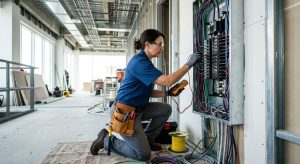
Once permitting is squared away, the electrical scope of a subpanel installation follows familiar fundamentals: a load calculation to size the subpanel correctly for the structure it serves, a feeder circuit run from the main panel sized for that load, and proper grounding and bonding at the subpanel itself, which requires a separate ground rod system and specific bonding rules distinct from the main service panel. For outdoor or semi-exposed subpanels near a pool equipment pad, weatherproof, corrosion-resistant enclosures matter more in Malibu’s coastal environment than they would further inland, since salt air accelerates corrosion on standard enclosures the same way it does on exposed fixtures and connectors.
Disconnect placement is worth planning carefully in a wildfire-prone area. A subpanel serving a detached structure needs a clearly accessible disconnect, and in a property with limited defensible space or specific fire department access requirements, where that disconnect sits relative to the structure and the property’s access routes can be part of what the fire department reviews alongside the building plans themselves. Feeder cable routing also deserves attention on hillside lots, since trenching across steep terrain to reach a detached pool house or guest structure can trigger its own grading review separate from the electrical permit, particularly on properties where soil stability or erosion control is already a planning department concern. Overhead runs are sometimes proposed as an alternative to trenching on difficult terrain, but they carry their own wildfire-related scrutiny in a VHFHSZ, since exposed overhead conductors are generally viewed less favorably than properly buried feeder cable in fire-prone areas.
Coordinating With Southern California Edison
If a subpanel project is modest in scope and the main service has adequate capacity, Southern California Edison typically is not directly involved beyond standard metering. Larger projects, particularly those adding a subpanel alongside a full main panel upgrade to support multiple new structures, may require SCE coordination for a service capacity increase, which adds its own scheduling lead time on top of the city’s permitting timeline. Planning for this lead time from the start of the project avoids a scenario where the electrical work is ready to proceed but is waiting on a utility-side approval that was not accounted for in the original schedule. Homeowners should ask directly, early in the planning process, whether their specific project scope is likely to require SCE involvement, rather than discovering the answer only once the city permit is already in hand and the contractor is ready to schedule work.
Properties adding several detached structures over time, a guest house one year, a pool house the next, an ADU after that, sometimes reach a point where the cumulative load across all those subpanels genuinely exceeds what the original service was sized for, even though each individual addition seemed modest on its own. A licensed electrician evaluating a new subpanel request should factor in the property’s overall electrical history, not just the load of the single new structure, to catch this kind of gradual capacity creep before it becomes a problem during a future addition.
Planning the Project Timeline Realistically
Homeowners who go into a Malibu subpanel project expecting the same timeline as a comparable job in a neighboring, less fire-restricted city are often the ones most frustrated by the process. Building in extra time for Chapter 7A plan review, potential fire department conditions, and coastal permitting where applicable, from the very first conversation with a contractor, sets realistic expectations rather than creating friction partway through. A contractor or electrician who has completed several Malibu projects will typically have a much more accurate sense of current department turnaround times than someone quoting based on experience in a different jurisdiction entirely.
Getting Subpanel Installation Right in Malibu
A subpanel for a Malibu guest house, ADU, or pool equipment setup is rarely complicated on the electrical side alone. What makes these projects take longer than they would elsewhere is the layered permitting environment that comes with being entirely inside a Very High Fire Hazard Severity Zone, much of it also within the Coastal Zone. Planning for that reality from the start, rather than discovering it partway through, is what keeps a Malibu subpanel project on schedule. A homeowner who understands going in that the fire department and, in many cases, the Coastal Commission are as much a part of this project as the electrician is far less likely to be caught off guard by the timeline, and far more likely to budget appropriately for a project that spans several months of review rather than a few weeks of construction alone.
If you’re tackling other property projects at the same time, our partners at Santa Monica plumbing services, the nearest of our partner locations to Malibu, handle plumbing work for coastal properties along the same stretch of coastline. For the electrical side, our subpanel installation team understands Malibu’s fire-zone and coastal permitting requirements, and our Malibu electricians can help you plan the project timeline realistically from the start, walking your property to identify which permitting layers your specific structure and location are likely to trigger before you invest in detailed plans.