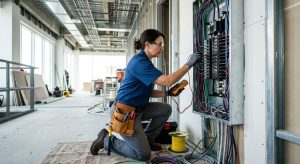
A panel upgrade for an EV charger is the single most common reason Los Angeles homeowners call an electrician after buying an electric vehicle. The charger itself is rarely the problem. The panel behind it, especially in a home built before the 1980s, often is. Before you buy a Level 2 charger, it helps to understand what your panel needs to handle, what the city requires, and where the real costs and savings are.
Why Los Angeles Homes Keep Running Into Panel Limits
Los Angeles has one of the highest rates of EV ownership in the country, and that demand is landing on housing stock that was never designed for it. A Craftsman bungalow in Highland Park, a 1960s ranch in the Valley, or a mid-century apartment building in Mid-City typically shipped with a 60 or 100 amp panel. That was plenty of capacity for lights, a refrigerator, and a window air conditioner. It is not enough once you add a 240-volt, 40 to 50 amp circuit for a Level 2 charger on top of central air, an electric range, and everything else drawing power during a summer afternoon.
The city’s electrical inspectors see this pattern constantly: a homeowner buys a charger, a licensed electrician runs a load calculation, and the math shows the existing service is already close to its limit before the charger is even added. That is not a reason to panic. It is a reason to get the assessment done early, before the charger shows up in a box in your garage.
Warning Signs Your Panel Can’t Handle a Level 2 Charger
A licensed electrician will run a formal load calculation, but a few signs tend to show up long before that appointment:
- Breakers trip when you run the air conditioner, the dryer, and the microwave at the same time
- Lights dim or flicker when a large appliance kicks on
- Your panel still uses fuses, or is rated below 100 amps
- Your insurance company has flagged the panel brand or age during a policy review
- You already have a waitlist of planned upgrades: a heat pump, an induction range, an ADU
None of these guarantee you need a full panel upgrade. Some homes have enough spare capacity, or can use load management technology that shares power between the charger and existing circuits without a full service upgrade. That determination should come from a licensed electrician’s load calculation, not a guess based on the panel’s age alone.
Load management is worth understanding before you rule it out. Rather than resizing the entire electrical service, a load management device monitors real-time demand across your home and automatically reduces or pauses charging when other high-draw appliances, like a central air unit or an electric range, are running at the same time. For a household that only needs to top off a car overnight, this can be a genuinely practical alternative to a full 200 amp service upgrade, especially on a property where trenching or panel relocation would add significant cost. It is not the right fit for every home. If you are also planning a heat pump conversion, an ADU, or a second EV in the near future, a full panel upgrade tends to be the more durable investment, since it gives you headroom for everything at once rather than solving one problem at a time.
What a Panel Upgrade for an EV Charger Actually Involves
When an upgrade is genuinely needed, the project generally follows five stages: a load calculation and site assessment, a decision on the right amperage (typically 200 amps for most single-family homes adding a charger), permit filing, coordination with the Los Angeles Department of Water and Power for any service changes, and a final inspection before the charger goes live.
Typical timeline
- Load calculation and assessment: same day to 2 days
- LADBS Express Permit (no plan check): often issued online, same day
- LADWP service assessment (if a new service is needed): 1 to 3 weeks
- Installation and final inspection: 1 day install, inspection within days
For most single-family homes, the Los Angeles Department of Building and Safety issues an Express Permit for standard EV charger and panel upgrade work, which skips the longer plan-check process required for more complex commercial jobs. LADWP has confirmed it now includes EV chargers on that Express Permit list specifically to speed up residential installs.
How LADWP and LADBS Coordinate the Process
If your project only involves a dedicated circuit and your existing service has enough headroom, your electrician can usually get an LADBS permit and move straight to installation and inspection. If the load calculation shows you need a new panel or a full service upgrade, the process adds a step: LADWP has to assess and approve the change to your electrical service before the meter or riser work happens. According to LADWP’s own charger installation guidance, the utility and LADBS have specifically partnered to streamline this handoff so homeowners are not stuck waiting between two separate city departments.
In practice, that means your electrician requests the service assessment, LADWP evaluates whether the existing infrastructure supports the upgrade, the electrician pulls the LADBS permit, the work gets done, and LADBS transmits the inspection approval back to LADWP so the utility can complete any meter work. It sounds like a lot of handoffs, but a contractor who does this routinely in Los Angeles will already know which office to call and when.
What It Actually Costs
Costs vary widely depending on whether you need a charger-only install or a full panel upgrade. A straightforward Level 2 charger installed close to an existing panel with enough spare capacity is a relatively contained job: the electrician mounts the charger, runs a short dedicated circuit, and files the permit. A project that requires a new 200 amp panel, updated grounding and bonding, and coordination with LADWP for a service change is a considerably larger scope, and the price reflects that difference.
Several factors move the total more than homeowners expect. The physical distance between the panel and the parking spot matters a great deal, since every additional foot of conduit and wire adds labor and material cost, and a run through finished walls or an attic costs more than an open garage wall. Homes with longer wiring runs from the panel to the parking spot, detached garages requiring trenching, or hillside lots in areas like Silver Lake and the Hollywood Hills should expect costs on the higher end of any range a contractor quotes. Whether the charger is hardwired or plugs into a dedicated outlet also affects price and, in some cases, warranty terms from the charger manufacturer. Finally, if your project triggers the 2026 code’s outdoor service disconnect requirement, discussed below, that adds a line item that would not have applied to a similar project just a couple of years ago.
The most reliable way to get an accurate number is a load calculation and an in-person quote, since panel age, wire routing, and the specific charger you choose all move the total more than any single factor on its own. A homeowner comparing quotes should ask each electrician to itemize the charger, the circuit work, permit fees, and any panel or service upgrade separately, rather than accepting a single bundled number that makes it hard to tell what you are actually paying for.
“If a breaker starts tripping the week after your EV charger goes in, don’t just keep resetting it. That’s the panel telling you something, usually that the circuit is carrying more than it was ever sized for, and it needs a licensed electrician to look at it before it becomes a bigger problem.”
– Edgar, Local Trusted Electricians
Rebates and the Federal Tax Credit Deadline
LADWP offers a rebate of up to $1,000 toward the purchase and installation of a qualified Level 2 home charger, with an additional $500 available to customers enrolled in LADWP’s Lifeline or EZ-SAVE assistance programs, bringing the total to as much as $1,500. Customers who install a dedicated EV meter can apply for an additional $250 rebate on top of that.
Separately, the federal government offers a tax credit under Section 30C for alternative fuel vehicle refueling property, worth 30 percent of installation cost up to $1,000 for a personal residence. This is not automatic everywhere: the IRS requires the property to be installed in an eligible census tract, generally a low-income or non-urban area, so it is worth checking your address before assuming the credit applies. The credit also has a hard deadline. Under recent federal legislation, equipment must be placed in service by June 30, 2026, after which the credit is no longer available for new installations.
These programs can be combined with each other, but each has its own paperwork and its own deadlines, so it is worth confirming eligibility before you commit to a charger model or an installation date.
Craftsman and Mid-Century LA Homes: The Aluminum Wiring Factor
Los Angeles has an unusually large stock of homes built between 1965 and 1973, exactly the window when many builders substituted aluminum wiring for copper due to rising copper prices. According to the U.S. Consumer Product Safety Commission, homes wired with the aluminum used before 1972 are 55 times more likely to have a connection reach fire hazard conditions than a home wired with copper. That risk is concentrated at connection points such as outlets, switches, and breaker terminals, not the wire itself.
This matters for EV charging because a new 240-volt, 40 to 50 amp circuit puts real, continuous load on whatever it is tied into. If your home falls into that 1965 to 1973 window, or has cloth-insulated wiring from the Craftsman era common in neighborhoods like Highland Park and Echo Park, a licensed electrician should evaluate the panel and the specific circuit path before running power to a new charger, not just the charger location itself.
New 2026 Code Requirements for EV Circuits
The 2026 update to the National Electrical Code introduces changes that are directly relevant to EV charger installations. Receptacles used for EV charging must now be specifically listed and rated for that use, rather than relying on a generic 240-volt receptacle, and the product standards for these EVSE-rated receptacles are still catching up to the code language, which means an installer needs to confirm current listing status with the manufacturer rather than assume any 240-volt receptacle will qualify. The code also introduces high-frequency ground fault protection requirements for certain outdoor circuits, addressing a known issue where inverter-based equipment, including some EV chargers and modern variable-speed HVAC systems, can interact with older-style GFCI protection in ways that cause nuisance tripping rather than genuine safety response. That is not the GFCI malfunctioning; it is older protection technology and newer inverter-based equipment simply not being designed for each other. A licensed electrician who stays current on these changes will factor them into the circuit design rather than defaulting to whatever was standard practice five years ago.
Separately, any project that involves replacing the service panel itself, as opposed to just adding a circuit, now triggers a requirement for an outdoor emergency disconnect marked clearly for first responders. Simply changing a meter or adding a subpanel does not trigger this requirement on its own, but a full panel replacement does, and it is a cost homeowners should ask about upfront rather than discovering partway through a project.
Why This Isn’t a DIY Project
A Level 2 charger circuit is not a weekend wiring project, even for a handy homeowner. It involves a dedicated 240-volt circuit sized correctly for continuous EV charging load, proper grounding and bonding at the panel, and in many cases coordination with LADWP that a homeowner cannot initiate directly. Beyond the technical requirements, unpermitted electrical work can also complicate a future home sale, since buyers and their inspectors routinely check for permit history on panel and circuit work in Los Angeles, and an unpermitted panel change can become a negotiating point or, worse, an insurance problem down the road.
There is also a safety dimension that is easy to underestimate. A 240-volt circuit sized for continuous EV charging load runs hotter and longer than most household circuits, since a car can draw power for six or more hours at a stretch. A loose connection or an undersized wire on a circuit like that has more time to build heat than a circuit that only runs in short bursts, which is part of why the code treats EV circuits with a specific EVSE-rated receptacle requirement rather than lumping them in with ordinary 240-volt outlets.
Our panel upgrade and EV charger installation teams handle the load calculation, the LADBS Express Permit filing, and the LADWP coordination as one package, so you are not the one relaying messages between two city departments.
Getting Your Los Angeles Home EV-Ready the Right Way
Whether your home needs a full panel upgrade or just a properly sized dedicated circuit, the right first step is the same: get a load calculation from a licensed electrician before you buy a charger, not after. That single appointment tells you whether you are looking at a straightforward install or a bigger project, and it puts you in position to apply for LADWP and federal incentives with accurate numbers instead of guesses.
If you are weighing other upgrades at the same time, a related project worth asking about is Santa Monica plumbing services from our partner network, useful if your electrification plans include a heat pump water heater alongside the EV charger. For electrical work specifically, our Los Angeles electricians can walk your property, run the numbers, and tell you plainly whether your panel is ready for a charger or needs an upgrade first.