An electrical panel upgrade is one of the most common projects our Pasadena electricians get called out for, and in a city full of Craftsman bungalows and Spanish Colonial homes from the 1920s through the 1940s, the reason is almost always the same: a split-bus panel installed decades ago that no longer matches what the home actually needs. These panels are not rare or defective by design. They are simply an older way of doing things that modern code, modern loads, and modern safety expectations have largely left behind, and replacing one is usually the right call once a proper assessment confirms it.
Why Split-Bus Panels Show Up So Often in Pasadena’s Older Homes
Pasadena’s housing stock skews older than much of Los Angeles County, with entire neighborhoods like Bungalow Heaven and Madison Heights built out during the Craftsman and Spanish Colonial boom of the early twentieth century, and many of these homes were later updated during the split-bus panel’s popular era from the 1950s into the early 1980s. That combination, a home built decades before that panel style existed, then updated once during the split-bus era, and often left untouched since, is exactly the pattern that produces the panels electricians find most often across the city’s historic districts.
None of this means a split-bus panel is automatically unsafe. It means the panel deserves a specific kind of evaluation that a lot of homeowners are never told to ask for, because the panel can look completely normal from the outside while quietly falling out of compliance with a rule most people have never heard of. A home inspector doing a general pre-sale walkthrough may not catch it either, since spotting the issue requires actually counting breaker throws rather than just noting the panel’s age and brand.
What a Split-Bus Panel Actually Is
A conventional modern panel has one main breaker that shuts off all power to the house in a single motion. A split-bus panel does not. Instead, it divides the panel into two sections: an upper bus that typically feeds large 240-volt appliances like the water heater, range, and air conditioning directly, and a lower bus that feeds ordinary lighting and outlet circuits through one breaker in the upper section, often labeled “Main” or “Main Lighting.” Flipping that one labeled breaker only kills the lower section. The 240-volt circuits in the upper section stay live.
This was a completely normal, code-compliant design when these panels were installed. It only becomes a problem when the specific rules that made it acceptable stop being followed, which happens more often than most homeowners realize.
The Six-Throw Rule: What Code Allows and What It Doesn’t
For decades, the National Electrical Code allowed a split-bus panel design as long as the entire home’s power could be shut off using no more than six breaker throws, commonly called the six-throw rule. A well-maintained split-bus panel with, say, three or four large double-pole breakers in its upper section still meets that rule and still qualifies as a legitimate, code-compliant panel for its era, even by today’s standards for existing installations.
The trouble starts with modification. As Pasadena homeowners over the decades added circuits, central air conditioning, and other loads, some of that upper bus space got converted from double-pole 240-volt breakers into additional single-pole breakers to squeeze in more circuits. Every time that happens, the number of throws needed to fully de-energize the panel goes up. A panel that started at four throws can end up needing nine or ten after enough piecemeal changes, at which point it is out of compliance with the six-throw rule even though nothing about its outward appearance changed.
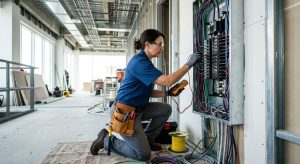
This is also why a split-bus panel is easy to misdiagnose during a casual inspection. A home inspector or even an electrician glancing at the panel from across the garage can see six or seven breakers up top and assume the panel is fine, without actually counting how many separate throws are required to kill every circuit. A proper compliance check means opening the panel, tracing which breakers feed the lower bus versus which feed dedicated appliance circuits directly, and counting the actual number of switch positions needed, not just eyeballing the breaker count.
Why a Split-Bus Panel Complicates a True Emergency Shutoff
The six-throw rule exists for a practical reason, not just a paperwork one. In an emergency, whether that is a fire, a flooding basement, or simply a homeowner who needs to work on their own wiring safely, the time it takes to identify and flip multiple breakers matters. A single main breaker is something almost anyone in a household can be told to find and flip in a hurry. A split-bus panel that needs eight or nine throws to fully de-energize is a much harder thing to execute correctly under stress, and it creates a specific hazard: someone flips the breaker labeled “Main,” assumes the power is off, and starts working near a 240-volt circuit in the upper section that is still fully energized.
This scenario comes up more than homeowners expect during otherwise routine tasks: replacing a light fixture, troubleshooting an outlet, or letting a handyman “just take a quick look” at something in the garage where the panel lives. The assumption that flipping one labeled breaker means the whole house is de-energized is exactly the gap between what a split-bus panel appears to do and what it actually does, and it is the kind of assumption that a licensed electrician is trained to check rather than take at face value.
“We still see homeowners in Bungalow Heaven who think they’ve killed all the power because they flipped the breaker labeled Main. In a lot of these older panels, that only kills the lights and outlets. The dryer, the range, and the AC circuit up top are still live, and that’s a dangerous assumption to make without checking first.”
– Marco, Local Trusted Electricians
Split-Bus Panels and Portable Generators
Pasadena’s wind and fire season exposure makes backup power a common request alongside panel evaluations, and this is another place split-bus panels create friction. A generator interlock kit is designed to physically prevent a panel from being connected to both utility power and a generator at the same time, and most interlock kits are built around locking out a single main breaker. Without a true main breaker to interlock against, a split-bus panel often cannot accept a standard interlock kit safely, which means homeowners in these homes considering a generator setup are usually looking at a panel upgrade as a prerequisite, not an optional add-on.
Knob-and-Tube and Early Aluminum Wiring: The Other Half of the Story
The panel is rarely the only original component in a Pasadena Craftsman or Spanish Colonial home. Many of these houses still have sections of knob-and-tube wiring from their original construction, and homes updated during the aluminum wiring era of the mid-1960s to early 1970s sometimes have that material mixed in as well. Neither of these on its own is an automatic hazard, but both change how a panel replacement project gets scoped, since the electrician has to evaluate not just the panel but what it is actually connected to before recommending a path forward.
A full assessment in these homes typically looks at the panel, the wiring type feeding each major circuit, and the condition of connections at outlets and switches, since deterioration at those connection points is where most of the real risk concentrates in older wiring systems. It is common for a Pasadena Craftsman to have a layered history: original knob-and-tube in some rooms, a section rewired with aluminum during a 1960s remodel, and a more recent partial rewire in whatever room was last renovated. Untangling which wiring type serves which circuit is a meaningful part of the assessment, not a formality, because the safe upgrade path for a knob-and-tube circuit is different from the safe correction method for an aluminum-wired one, and a panel replacement project needs to account for both if the home has them.
What a Panel Upgrade for a Historic Pasadena Home Involves
Replacing a split-bus panel with a modern single-main panel is a well-understood project for an electrician experienced in older housing stock, but it involves more careful planning in a historic home than in a newer one. The work typically includes a load calculation to size the new panel correctly, coordination with Pasadena Water and Power for any service changes, and attention to how the work is done around plaster walls and original woodwork, since these homes often have preservation-minded owners who care as much about the finished appearance as the electrical outcome. A licensed electrician who regularly works in Pasadena’s historic districts will plan cable routing with that in mind, rather than taking the shortest path through a wall that happens to be original to the house.
Timing matters too. A panel replacement means the home is without power for at least part of a day, and coordinating that around Pasadena Water and Power’s scheduling, rather than assuming the utility can accommodate any date an electrician proposes, avoids the frustration of a project stalling out partway through. Homeowners planning other work at the same time, such as a kitchen remodel or an ADU addition, often find it more efficient to fold the panel upgrade into that broader project timeline rather than scheduling it as a separate, standalone job.
The 2026 Code’s New Outdoor Disconnect Requirement
The 2026 National Electrical Code introduces a requirement that all service disconnects for one and two family dwellings be located outside the building, with clear “Emergency Disconnect” marking so first responders can find and operate it quickly, even at night. This requirement is triggered specifically by replacing the service panel itself. Simply changing a meter or upgrading a subpanel does not trigger it, but a full split-bus to single-main panel replacement does, which means it is a cost consideration worth discussing upfront rather than as a surprise mid-project. For a homeowner already planning a panel upgrade to resolve six-throw rule compliance, this requirement folds into the same project rather than adding a separate one later.
Coordinating With Pasadena Water and Power and the City
Panel replacement projects in Pasadena route through Pasadena Water and Power for service coordination and through the city’s Planning and Community Development Department for permitting, a slightly different path than the LADWP and LADBS process used just a few miles away in Los Angeles proper. An electrician who works regularly in Pasadena will already know which office handles which part of the process, which matters more in a city with historic district overlays, since some neighborhoods carry additional review requirements for exterior work, including where an outdoor disconnect can be mounted on a home with a protected facade.
This distinction trips up homeowners who assume electrical permitting works the same way across every city in the region. Pasadena is its own municipality with its own utility and its own planning department, separate from both the City of Los Angeles and Los Angeles County, and a contractor unfamiliar with that difference can end up filing paperwork with the wrong agency or missing a historic district requirement that only applies within Pasadena’s boundaries. Confirming your electrician has actual, recent experience with Pasadena’s specific process, not just general Los Angeles County experience, is a reasonable question to ask before signing a contract.
Getting a Straight Answer on Your Pasadena Panel
A split-bus panel in a Pasadena Craftsman or Spanish Colonial home is not automatically a problem, but it is also not something to assume is fine just because the lights still turn on. The six-throw rule, the wiring behind it, and the home’s specific permitting path all deserve a genuine evaluation rather than a guess based on the panel’s age alone. This is especially true for homeowners planning a sale, since a panel that fails a basic compliance check during a real estate inspection can become a negotiating point at the worst possible time in a transaction.
If you are tackling other home projects at the same time, our partners at Pasadena plumbing services handle plumbing work across the same historic neighborhoods. For the electrical side, our electrical panel upgrade and aluminum wiring replacement teams work regularly in Pasadena’s historic neighborhoods, and our Pasadena electricians can walk your property and tell you clearly whether your panel meets today’s safety expectations or needs attention.