Table of Contents
- Understanding the Risks and Costs of Federal Pacific Panels
- Fire Risks and Safety Hazards of Federal Pacific Stab-Lok Panels
- Why Home Insurance Companies Require Federal Pacific Panel Replacement
- Full Panel Upgrade vs. Circuit Breaker Replacement: Making the Safe Choice
- Federal Pacific Panel Replacement Cost in California and New Jersey
- Navigating California and New Jersey Electrical Codes with Permit-Ready Work
- Safeguard Your Home with Expert Electrical Panel Replacement
Understanding the Risks and Costs of Federal Pacific Panels
Homeowners exploring Federal Pacific panel replacement costs in Anaheim should understand the safety hazards involved before scheduling any upgrade. These Stab-Lok panels, widely installed in older homes, have a well-documented history of breaker malfunctions that fail to trip during overloads, creating serious fire risks. Internal components may overheat and damage wiring connections over time, and panels that appear functional can harbor defects that pose immediate threats to household safety.
Replacement costs depend on panel capacity, labor, and local permit fees. In Anaheim, a full electrical panel replacement requires building permits and compliance with the California Electrical Code, ensuring that the upgrade is inspected and meets utility standards. At Local Trusted Electricians, our licensed and insured electricians provide transparent, fixed upfront quotes for every Federal Pacific panel replacement, managing all permitting and inspections for full code compliance.
Understanding these risks begins with a closer look at the specific fire hazards posed by Federal Pacific Stab-Lok panels.
Fire Risks and Safety Hazards of Federal Pacific Stab-Lok Panels
Federal Pacific Stab-Lok electrical panels have earned a troubling reputation across the home safety and insurance industries. Installed in millions of residences primarily between the 1950s and 1980s, these panels are now widely flagged as posing a significant fire risk. As aging electrical infrastructure draws increased scrutiny, the specific hazards associated with Stab-Lok breakers have become impossible for insurers and homeowners to ignore.
The core danger lies in the breakers’ tendency to fail during an overload condition. When a circuit draws more current than it is designed to handle, a properly functioning breaker should trip to interrupt the flow of electricity and prevent overheating. According to insurance industry insight from Freeman, Belsky & Associates (FBIA), Federal Pacific Stab-Lok breakers often fail to trip under these circumstances. This malfunction allows wires to carry excessive current without interruption, generating heat that can degrade insulation, melt components, and ultimately ignite surrounding materials. The result is a well-documented fire hazard that exists inside walls and electrical enclosures where detection may be delayed.
Insurance companies have responded to these documented risks with increasingly firm requirements. As FBIA explains, many home insurers now decline coverage or issue non-renewal notices when an inspection reveals a Federal Pacific panel. In California, where the insurance market has tightened significantly, carriers are required by state law to provide at least 75 days’ advance notice before a non-renewal takes effect. That window is intended to give homeowners time to arrange a licensed electrician to perform a full panel replacement. Underwriters typically mandate that the work be completed to current code standards and documented with permits and inspection sign-offs before they will issue or reinstate a policy. This direct link between the inherent fire risks of Stab-Lok panels and underwriter requirements underscores why addressing outdated equipment is not only a safety measure but also a practical necessity for maintaining home insurance. We encourage homeowners to schedule a professional inspection to identify any panel issues before they trigger an insurance cancellation or, worse, a preventable fire.
Why Home Insurance Companies Require Federal Pacific Panel Replacement
Because Federal Pacific Stab-Lok panels are well-documented fire hazards, home insurance companies now treat them as a high-risk condition that triggers strict requirements. According to industry sources, insurers frequently decline applications or issue non-renewal notices for homes that still have these outdated panels. The breakers inside FPE Stab-Lok units may fail to trip during overloads, directly increasing the risk of electrical fires—a risk underwriters are no longer willing to accept. A homeowner may not discover the issue until a routine insurance inspection uncovers the panel and flags the policy for cancellation.
In response, most underwriters require a full panel replacement performed by a licensed electrician before they will write a new policy or renew an existing one. A complete panel upgrade eliminates the fire hazard and provides documented proof for the insurer. California law adds a critical deadline: insurance carriers must give policyholders at least 75 days’ notice before a non-renewal takes effect. That window allows homeowners time to schedule a replacement and submit the required documentation—typically an electrician’s invoice, the permit, and the final inspection sign-off.
For a homeowner concerned about insurance coverage, the first step is to identify the panel brand. Look for “FPE,” “Federal Pacific,” or “Stab-Lok” printed on the panel cover or interior labeling. If an FPE panel is present, contacting your insurance provider to confirm their exact requirements is essential. At that point, we can step in with a thorough electrical safety inspection and a fixed-quote panel upgrade. Our licensed and insured electricians handle every detail, from pulling the permit to coordinating the utility disconnect and scheduling the final inspection. We present you with a fixed quote before work begins so you know exactly what the upgrade involves and can provide the documentation your insurer needs. While we cannot guarantee that every insurer will automatically accept the work, providing a professional, permit-verified panel replacement is the standard path to resolving coverage issues.
That’s why most homeowners facing this situation opt for a complete panel upgrade rather than a partial breaker replacement—it addresses the root cause of the risk and aligns with today’s underwriting standards. We’ll help you evaluate that choice in clear, practical terms.
Full Panel Upgrade vs. Circuit Breaker Replacement: Making the Safe Choice
Industry sources report, insurers frequently deny policies or issue non-renewal notices unless the full panel is replaced—not just a few faulty breakers. In California, carriers must give at least 75 days’ notice before dropping coverage, giving homeowners a narrow window to act. Knowing that a breaker swap alone will not restore insurability is the first step toward a lasting solution.
We help property owners evaluate two paths: a targeted circuit breaker replacement or a full panel upgrade. While swapping out a worn or tripping breaker can address an immediate issue, it does nothing to resolve the underlying fire risk that Federal Pacific equipment is known for. In most cases, only a full panel upgrade satisfies the safety standards and documentation requirements insurance underwriters demand.
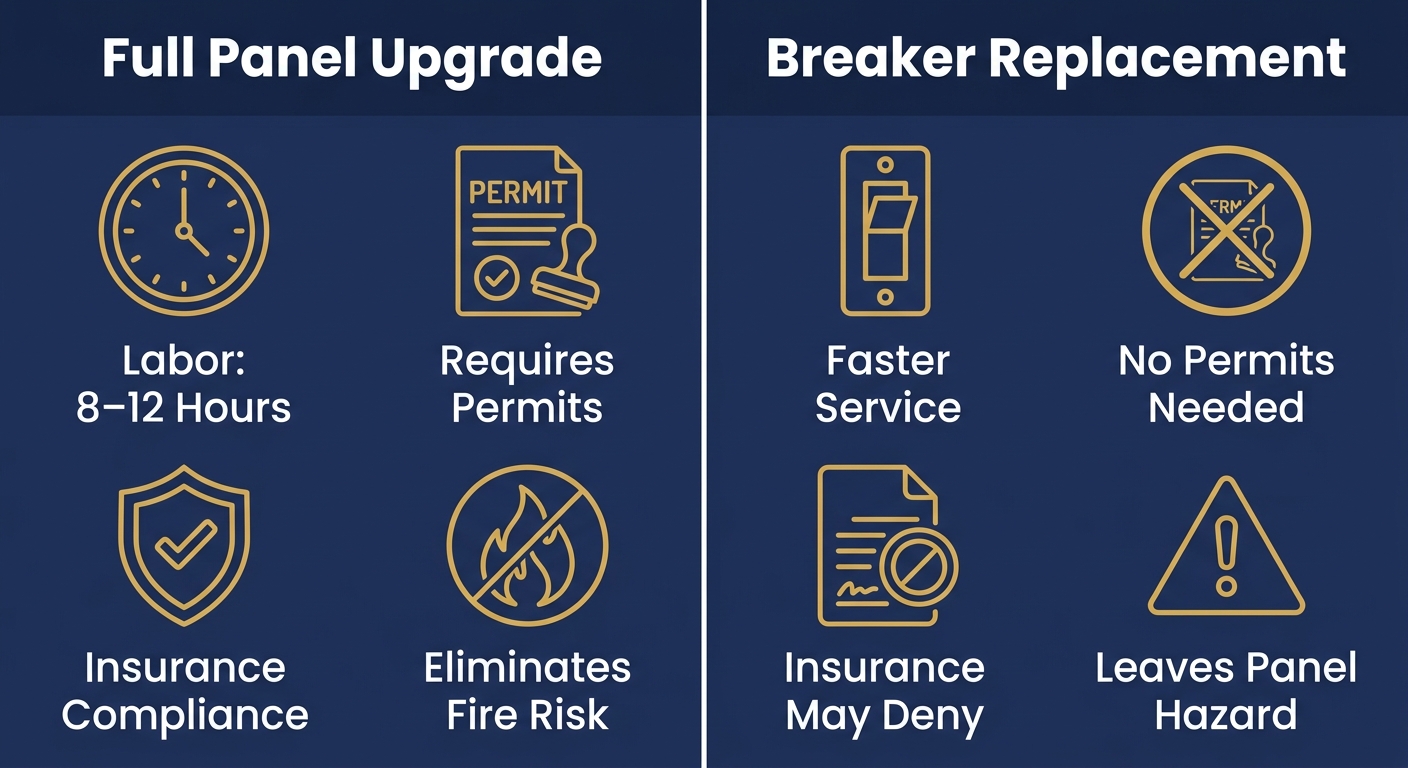
A full panel replacement involves removing the hazardous equipment entirely and installing a modern, code-compliant panel. Based on our own internal guide, a standard upgrade typically requires eight to twelve hours of on-site labor after diagnostics. Every full replacement we handle includes pulling the necessary permits and completing the work to pass inspection—our team is built around permit-ready work that meets local utility requirements in Anaheim, across California, and in New Jersey. Only a licensed electrician can provide the permits, final sign-offs, and professional documentation insurers ask for.
In contrast, a simple breaker replacement skips permits entirely, does not improve arc-fault or ground-fault protection, and offers no path to future capacity gains. When a home’s electrical load is growing—perhaps to accommodate an EV charger or a new appliance—a panel upgrade often includes increasing to 200-amp service, which naturally affects the overall 200 amp service upgrade cost. Without that upgrade, the system remains undersized and may still present an insurance risk.
The scope of the work—from a one-breaker fix to a full panel and service upgrade—directly shapes the final investment. Understanding these fundamental differences makes the cost breakdown in the next section more practical. We provide transparent, fixed upfront quotes so you can make an informed, safety-first decision without surprises.
Federal Pacific Panel Replacement Cost in California and New Jersey
Federal Pacific Electric (FPE) Stab-Lok panels are linked to a higher risk of electrical fires, and many insurers now require replacement as a condition of coverage. The cost of a Federal Pacific panel replacement in California and New Jersey depends on several predictable factors that homeowners should consider when comparing repair options and insurance requirements.
Key cost factors include:
- Labor: A standard panel upgrade typically requires 8 to 12 hours of skilled electrical work after diagnostics; older homes or difficult access can increase labor time.
- Permits: Building permits are generally required for full panel replacements in California (per local code), adding permit fees and inspection steps to the project timeline.
- Materials: Upgrading to a modern panel with Arc-Fault Circuit Interrupter (AFCI) protection—required by the California Electrical Code for many circuits—increases material complexity compared with a simple breaker swap.
- Local utility coordination: Some jurisdictions require coordination with local utilities for disconnect/reconnect; our local expertise across California and New Jersey helps manage utility interactions to reduce delays.
We provide fixed upfront quotes after an on-site assessment, pull required permits, and deploy licensed, insured electricians to perform permitted, code-compliant work.
| Service Type | Estimated Cost | Permit & Code Requirements | Insurance Acceptance | Safety Impact |
|---|---|---|---|---|
| Full Panel Replacement | Higher cost due to labor, permits, and materials | Building permit required; must meet current code (AFCI, etc.) | Often required by insurers for coverage | Eliminates the fire risk associated with FPE panels |
| Circuit Breaker Replacement Only | Lower cost but limited benefit | Permit may not be required for breaker swap alone | Insurers may still not accept because panel remains | Does not resolve the panel’s known failure hazard |
| Subpanel Installation | Moderate cost; increases capacity but leaves main panel | Permit typically required for new subpanel | Insurers may still require main panel replacement | Distributes load but does not remove original FPE risk |
Understanding these cost and safety trade-offs is the first step. We manage permit submission and municipality requirements so you receive a permit-ready installation and a fixed upfront quote to move forward with confidence.
Navigating California and New Jersey Electrical Codes with Permit-Ready Work
After considering the investment involved in replacing an outdated panel, it’s equally important to understand the regulatory requirements that govern electrical work in California and New Jersey. Local building codes are not optional—they are the foundation of every safe, reliable panel upgrade.
Both states require building permits for any full panel replacement or service upgrade. In California, the California Electrical Code (based on the National Electrical Code with state-specific amendments) mandates Arc-Fault Circuit Interrupter (AFCI) protection on new circuits, and every installation must align with utility standards from providers like SCE, LADWP, or PG&E. New Jersey enforces its own state adoption of the National Electrical Code, which includes local provisions for load calculations and equipment grounding. When you add high-demand equipment—such as an EV charger, induction cooktop, or smart home automation panel—proper circuit sizing and overcurrent protection become critical, making code compliance non-negotiable.
We are licensed under the California Contractors State License Board (license #1034067), and our electricians hold state-level licenses, bonding, and insurance in both California and New Jersey. Every job begins with a thorough evaluation of your existing system and load demands. We then handle the entire permit process: submitting plans and calculations to the local building department, coordinating the inspection, and completing the work to pass inspection. A standard panel upgrade typically takes eight to twelve hours of labor once diagnostics are done, and we schedule the final inspection to align with project completion. We also coordinate with the local utility company when a service upgrade requires meter-base changes or line-side modifications.
This permit-ready approach eliminates guesswork and risk. Rather than leaving a homeowner to navigate unfamiliar codes or risk a failed inspection, we manage every detail. Permitted work also protects your property value and insurability—unpermitted electrical modifications can become a significant liability during a home sale or insurance claim.
Ultimately, navigating California and New Jersey codes with a permit-ready partner means your panel replacement is built on a foundation of safety and full compliance. This proactive process sets the stage for an expert electrical panel replacement that safeguards your home and your family.
Safeguard Your Home with Expert Electrical Panel Replacement
Armed with clarity on how permit-ready work keeps your project aligned with local requirements, the final consideration is peace of mind. Your home’s safety hinges on a reliable electrical backbone, yet many California properties still house outdated and hazardous panels. Insurance sources report that homes with Federal Pacific Stab-Lok or Zinsco panels frequently face policy denials or non-renewals, so prompt replacement by licensed professionals is a critical safeguarding step.
We make that protection accessible. Understanding the federal pacific panel replacement cost is a key part of protecting your home’s safety and insurance standing, and we provide fixed upfront quotes. Our licensed, insured electricians manage permits and coordinate inspections across 54 cities, and we install modern panels that support EV chargers, smart-home systems, and high-capacity appliances. Take the next step by calling (855) 904-2285 to schedule a consultation and secure the electrical reliability your home deserves.
Get Your Fixed Price Quote
Understanding the federal pacific panel replacement cost is just the first step toward protecting your home and maintaining insurance coverage. Our licensed and insured electricians at Local Trusted Electricians are ready to provide you with a transparent, fixed-price quote for your panel upgrade. We handle all necessary permits and inspections to ensure your home meets California and New Jersey electrical codes. With a 5.0-star rating and over 25 years of experience, we have helped thousands of homeowners eliminate the risks of hazardous Federal Pacific Stab-Lok panels. Home insurance companies often require full panel replacement by a licensed electrician to continue coverage, and we can help you meet those requirements. Contact us at (855) 904-2285 or visit our website to schedule your consultation and take the next step toward a safer home.