Table of Contents
- The Dawn of Electricity: Tracing the Invention That Changed the World
- Early Observations and the Discovery of Static Electricity
- The Pioneering Experiments of Benjamin Franklin and Luigi Galvani
- Michael Faraday and the Birth of Electromagnetic Generation
- Edison, Tesla, and the War of Currents: Practical Electricity for the World
- The Electrification of America and the First Home Electrical Installations
- From Discovery to Your Home: The Importance of Modern Electrical Expertise
The Dawn of Electricity: Tracing the Invention That Changed the World
At Local Trusted Electricians, we often hear the question: when was electricity invented? The answer is not a single date but a series of breakthroughs. In 1752, Benjamin Franklin’s kite experiment demonstrated lightning’s electrical nature, though it wasn’t practical power. The history of electricity truly advanced when Thomas Edison introduced the practical incandescent light bulb in 1879 and launched the Pearl Street Station in 1882, delivering electricity to homes in New Jersey. The question of who invented electricity gains a critical figure in Nikola Tesla, whose alternating current (AC) system, showcased with Westinghouse at the 1893 World’s Fair in Chicago, enabled long-distance transmission and made widespread electrification possible.
These innovations transformed household lighting and industrial machinery, laying the groundwork for modern life. Today, we carry that legacy forward with licensed and insured electrical services. Homeowners and businesses across California and New Jersey depend on licensed electrical contractors in California and New Jersey to keep their power safe—a direct continuation of that pioneering spirit.
Early Observations and the Discovery of Static Electricity
When we explore the origins of modern electrical systems, the question of when was electricity invented takes us back over 2,600 years. Ancient Greek philosopher Thales of Miletus noticed that rubbed amber attracts lightweight objects—the first recorded observation of static electricity. Static electricity, often dismissed as a minor curiosity, actually marks the dawn of electrical science. This simple discovery initiated a centuries-long journey of inquiry that laid the groundwork for today’s electrical age.
Thales observed that amber rubbed with fur could draw feathers and straw toward it—a phenomenon we now call static electricity. For centuries, this curiosity went without a systematic explanation. Then in 1600, English scientist William Gilbert published ‘De Magnete,’ a work that coined the term ‘electricus’ (from the Greek word for amber) and clearly distinguished electrical attraction from magnetic attraction. In the history of electricity, Gilbert’s contribution helped reframe the question of who invented electricity into a story of incremental progress.
In 1663, German inventor Otto von Guericke built the first electrostatic generator—a hand-cranked sulfur globe that produced sparks and static charge on demand. This machine allowed reproducible experiments, transforming electrical study from passive observation to active investigation. Decades later, in 1733, French scientist Charles du Fay discovered that static electricity existed in two varieties, which he termed vitreous and resinous; today we know them as positive and negative. These systematic researches finally gave a satisfactory answer to the question of when was electricity invented, pointing to the 17th and 18th centuries as the period when electricity became a scientific discipline.
These early static experiments set the stage for the dynamic discoveries of the 18th century, from Benjamin Franklin’s kite to the first batteries. Every modern circuit traces its heritage to those early amber-rubbing experiments. The National Electrical Contractors Association (NECA) emphasizes that understanding the history of electricity helps today’s professionals uphold safety and innovation. Today, these ancient observations underpin every electrical system, including those installed by a licensed residential electrician in San Diego. At Local Trusted Electricians, we honor that legacy by delivering professional, permit-ready electrical work across California.
The Pioneering Experiments of Benjamin Franklin and Luigi Galvani
From ancient amber experiments that sparked curiosity, the 18th century brought transformative breakthroughs. To understand when electricity was invented, one must first look to the pioneering work of Benjamin Franklin and Luigi Galvani. Their experiments reshaped how humanity understood this mysterious force.
In the history of electricity, few experiments are as celebrated as Benjamin Franklin’s legendary kite flight. In 1752, in Philadelphia, Franklin flew a kite into a thunderstorm, successfully drawing sparks from the key attached to the string and proving that lightning was electrical. This elegant demonstration shattered centuries of superstition. Franklin immediately recognized the practical potential, inventing the lightning rod to protect buildings by safely conducting strikes to the ground. His work demonstrated that electricity was not a mysterious fluid confined to static generators but a powerful force present in the atmosphere. While many who ask who invented electricity point to Franklin, his genius lay in discovery, not invention.
In the 1780s, Italian physician Luigi Galvani was dissecting frog legs when he noticed that they twitched upon contact with metal instruments. He reasoned that the tissues contained an inherent ‘animal electricity,’ a vital force that caused movement. This experiment challenged the belief that electricity was solely a property of inanimate objects. Galvani’s concept electrified the scientific community and directly influenced Alessandro Volta, who would later build the first battery. Though Volta contested Galvani’s conclusions, the debate propelled forward the understanding of bioelectricity. The history of electricity is richer for this rivalry, as it bridged living systems and electrical phenomena.
Today, we apply the principles discovered by these pioneers to deliver safe, transparent electrical services. Our licensed and insured team provides fixed quotes before work begins, ensuring you know exactly what to expect. For a detailed look at modern service costs, see our guide to residential electrician pricing in San Diego. Our local expertise extends to specialized installations like electric water heater installation, handled with the same commitment to precision that Franklin and Galvani pioneered. Franklin and Galvani opened the door; Volta would soon step through with the first true battery.
Michael Faraday and the Birth of Electromagnetic Generation
To understand when electricity was invented, we look to the 19th century and the work of English scientist Michael Faraday (1791–1867), working in the United Kingdom. The history of electricity gained a critical milestone when Faraday discovered electromagnetic induction in 1831. While many ask who invented electricity, Faraday’s demonstration of continuous current generation was the true beginning of the electrical age.
Prior to Faraday, electricity was largely a scientific oddity, known only through static discharges. In 1831, Faraday conducted his landmark experiment in the laboratory in London. He wrapped a copper wire coil around an iron ring and moved a bar magnet in and out of the coil’s center. Each motion induced an electric current, which he detected using a galvanometer. Unlike earlier electrostatic generators that produced only sparks, Faraday’s electromagnetic induction created a steady, continuous current – the first method to generate electricity reliably. The answer to when electricity was invented is closely tied to Faraday’s 1831 experiment.
Faraday’s breakthrough established electromagnetic induction as the core principle behind all modern electric generators, a milestone in the history of electricity. A key figure in the story of who invented electricity is Michael Faraday, because his work made continuous current production possible. Without this principle, large-scale electricity generation would be impossible – power plants rely on rotating magnets and coils, a direct descendant of Faraday’s iron ring and magnet. His discovery provided the scientific foundation for the first generators, transformers, and eventually the electrical grid.
Today, the continuous current that Faraday first demonstrated powers every modern home. An electric water heater, for instance, draws 4,500 watts and requires a dedicated 240-volt circuit – a demand that must be met with professional installation as outlined in our water heater installation guide. We, as modern electricians, ensure that Faraday’s principle is safely harnessed, providing licensed and insured services, fixed quotes before work begins, and local expertise.
Faraday’s discovery remains the bedrock of modern electricity, from power plants to every outlet in your home. Today’s electricians rely on electrical contractor association resources (such as NECA) for safety, training, and code compliance, ensuring permit-ready installations. In the next section, we’ll explain how this technology powers your daily life and why expert electricians are essential to keep it safe and reliable.
Edison, Tesla, and the War of Currents: Practical Electricity for the World
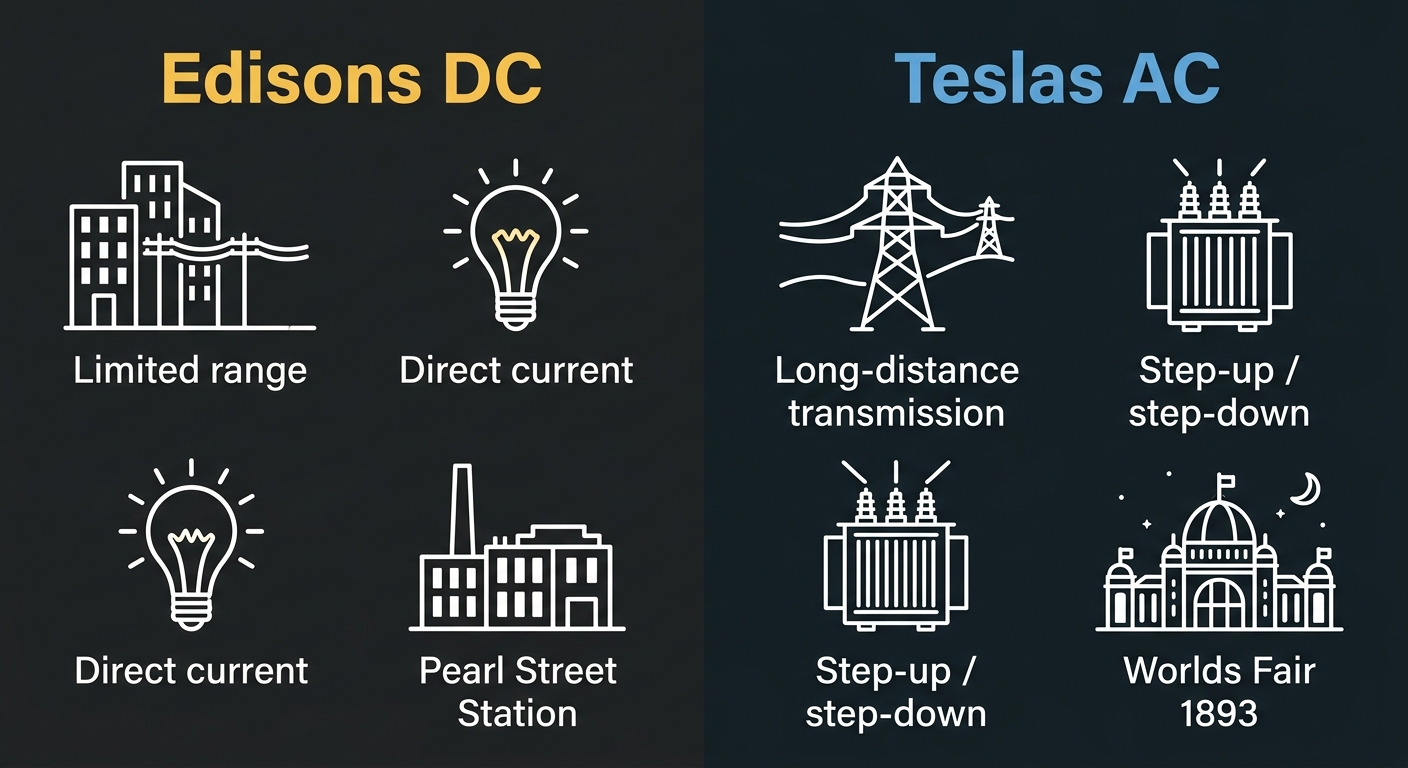
The question of when was electricity invented has no single answer, but practical electrical systems truly emerged in the late 1880s, driven by a fierce rivalry between Thomas Edison and Nikola Tesla. This period, known as the War of Currents, transformed how the world generates and distributes power. To understand who invented electricity as we know it, it’s important to examine both Edison’s direct current (DC) and Tesla’s alternating current (AC).
In 1882, Edison’s Pearl Street Station in New York City began illuminating a small section of Manhattan with DC. However, DC suffered a critical drawback: voltage dropped significantly over distance, limiting service to about a one-mile radius. This meant a dense network of small, local power stations would have been needed—a costly and impractical approach for electrifying entire cities.
After leaving Edison’s company, Nikola Tesla developed AC and the transformer. Unlike DC, AC could be stepped up to extremely high voltages for efficient long-distance transmission and then stepped down for safe residential use. This breakthrough promised to bring power to far-flung communities without the need for countless generating stations.
The history of electricity took a dramatic turn as Edison launched a fierce public campaign against AC, even demonstrating its danger with the electric chair to scare the public. Despite this, Tesla and industrialist George Westinghouse secured a major victory: their AC system illuminated the 1893 Chicago World’s Fair, proving its safety and scalability to the world. That moment marked the commercial triumph of AC, making large-scale, affordable electrification possible and ultimately powering factories, homes, and entire cities across the globe.
Today, the same AC principles deliver electricity to every outlet, but they also demand careful handling. At Local Trusted Electricians, we see this legacy in every modern electrical panel and circuit. Our licensed, insured professionals apply the rigorous standards developed over more than a century to ensure your home or business stays safe, code-compliant, and fully powered. The War of Currents may be history, but the need for skilled electrical work has never been more vital.
The Electrification of America and the First Home Electrical Installations
But how did we get here? Let’s rewind to the dawn of electricity. If you’ve ever wondered when was electricity invented, the answer starts with Benjamin Franklin’s famous kite experiment in 1752—a bold demonstration that revealed lightning’s electrical nature. However, the practical use of electricity for lighting and power wouldn’t emerge for over a century. The moment electricity truly entered daily life came in 1879, when Thomas Edison perfected the incandescent light bulb, followed by the 1882 launch of the Pearl Street Station in New York City, the first central power plant to distribute electricity to paying customers. That milestone turned the curiosity of when was electricity invented into a tangible reality that could illuminate homes.
The question of who invented electricity doesn’t have a single answer. While Franklin uncovered its fundamental properties, pioneers like Edison, Nikola Tesla, and George Westinghouse transformed those early insights into practical systems. Understanding the history of electricity helps us appreciate why the fierce War of Currents during the late 1880s mattered so much. Edison championed direct current (DC), which worked well but could not travel far, while Tesla and Westinghouse backed alternating current (AC), which could be sent over long distances at high voltages and then stepped down for safer household use. The debate wasn’t just technical—it shaped how entire cities would be wired, and ultimately AC prevailed for national grids.
When electricity first found its way into American homes in the late 1880s and 1890s, the installations were primitive by today’s standards. Wealthy early adopters like financier J.P. Morgan wired his Manhattan mansion with DC power and electric lights, but the work was done using rudimentary knob-and-tube wiring with a few outlets and bare-bulb fixtures—a far cry from the whole-home systems we design today. Cost was a barrier for most families, and the 1893 World’s Columbian Exposition in Chicago helped shift public opinion by dazzling visitors with AC-powered lighting, proving that electricity could be both practical and spectacular. These early installations also varied widely by region, influenced by the availability of local power plants and the skill of the installers. Just as modern homeowners rely on local expertise to navigate area-specific codes, early residential wiring depended heavily on whoever was available—often unskilled laborers rather than trained electricians.
Those dangers and inconsistencies sparked the push for safety standards. The National Electrical Code was first published in 1897, laying the groundwork for the rigorous, permit-ready work our customers expect today. As Local Trusted Electricians’ recent residential guide explains, the progression from knob-and-tube to modern panel upgrades and whole-home rewiring reflects over a century of continuous refinement. Early home systems might have consisted of a single circuit and a handful of lights, but they ignited a demand for safer, more capable electrical infrastructure—a responsibility we carry forward every time we pull a permit or wire a new EV charger in a Southern California home. Those early installations needed constant improvements—leading to the safety standards and professional, licensed service we rely on now.
From Discovery to Your Home: The Importance of Modern Electrical Expertise
While many homeowners wonder when was electricity invented, the answer reveals a journey that began with Benjamin Franklin’s 18th-century experiments and advanced through the commercial breakthroughs of Thomas Edison and Nikola Tesla. The history of electricity includes many pioneers; the question of who invented electricity thus involves numerous contributors. Today, residential electrical systems are far more complex and dangerous if mishandled, which is why modern expertise is essential.
We are Local Trusted Electricians, providing licensed & insured electricians with fixed quotes before work begins and same-day response. Our local expertise across California and New Jersey means we understand the specific codes in cities like Los Angeles, San Francisco, and Newark, ensuring your panel upgrades, rewiring, and safety inspections are permit-ready and verified for code compliance. We’ve gathered the key questions to ask a residential electrician to help you hire with confidence. When you choose us, you get a team committed to top-quality work and your family’s safety.